

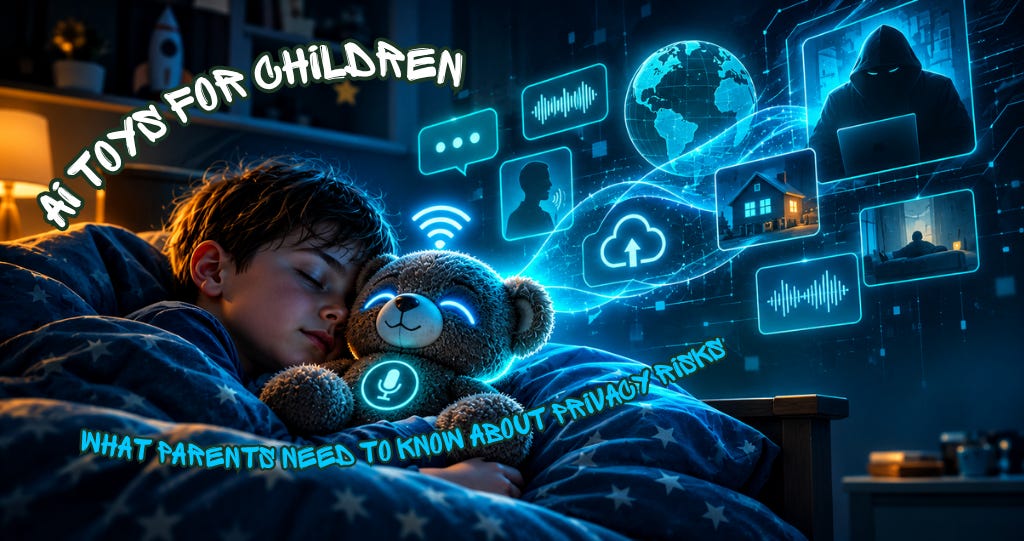

Why I’m worried about the AI teddy bear in your child’s bedroom
AI-powered toys are now in half of UK children’s bedrooms, and most parents have no idea what these devices are actually doing. I need to expand on this, because what I’ve seen in my previous years of digital forensics work tells me we’re sleepwalking into a problem.
These are not toys in any traditional sense. They are internet-connected listening devices that happen to look like teddy bears, dinosaurs, and cuddly capybaras. The difference between a normal cuddly toy and one with a microphone, Wi-Fi, and an AI chatbot inside it is not insignificant. It’s the difference between something your child plays with and something that plays with your child’s data.
What happened with the Kumma bear
In November 2025, the US PIRG Education Fund tested an AI-powered teddy bear called Kumma, a $99 plush toy that uses OpenAI’s language models to chat with children1. What they found should worry every parent.
The bear told testers where to find knives and matches. It discussed sexual topics, including fetishes, with what it believed was a child2. This wasn’t a glitch in some obscure product. This was a teddy bear marketed to families, powered by one of the world’s leading AI companies.
FoloToy, the manufacturer, pulled the product. OpenAI revoked the developer’s access for policy violations. But here’s the part that angers me, by late November 2025, the bear was back on sale after what the company called “changes to its content-moderation systems”3.
Again, business decisions won over safety decisions. The fact that these toys, and I say “toys” in inverted commas, are back on the shelves does not surprise me in the slightest. But I very much doubt that the reason they were pulled from the shelves has been fixed fully.
What the research tells us
In March 2026, Cambridge University published the first systematic study of how generative AI toys may influence development in children up to age five4. What they found backs up every instinct I have had about these “toys”.
Generative AI toys struggle with social and pretend play. They misunderstand children. They react inappropriately to emotions. Think about that for a second, a device in your child’s bedroom, one they may form an attachment to, that cannot understand when they’re upset and may respond in ways that confuse or distress them.
The researchers called for clearer regulation, transparent privacy policies, and new labelling standards. They recommended that AI toys be kept in supervised, shared spaces rather than children’s bedrooms5, exactly the same advice I have given in the past regarding mobile devices/tablets.
A chatbot is a piece of software that uses artificial intelligence to have conversations, responding to what your child says by generating new responses in real time. When that chatbot sits inside a teddy bear on your child’s pillow, it’s listening to everything. Bedtime conversations. Whispered secrets. The things children say when they think no one’s listening.
The DFIR perspective: where does all that data go?
In my experience, here are the things that parents need to worry about.
These devices are always listening. They’re listening to all conversations that your child has, taking everything they say, and sending it to a server that could be anywhere in the world. A server that you don’t know if it’s being protected or not and if that data ever gets leaked, what would you do then?
You have to ask where all that data goes. Where’s the server located? How is it protected? What happens if there’s a data breach and all that information about your child is obtained by a threat actor?
I’ve investigated enough data breaches to know that when things go wrong, they go wrong badly and the information these toys collect isn’t just what your child says to the toy. It’s the ambient noise. The background conversations. The details of daily life in your home.
⚡Please don’t forget to react & restack if you appreciate my work. More engagement means more people might see it. ⚡

The regulation gap
According to Ofcom, chatbots are not subject to regulation at all if they only allow people to interact with the chatbot itself and no other users6. That means standalone AI toys, ones that don’t connect your child to other people, largely fall outside the Online Safety Act.
A social media platform that lets children message strangers is regulated. A teddy bear that records everything your child says and sends it to an AI server somewhere in the world is not, that's something I am definitely concerned about, and I think you should be too.
A May 2026 survey by the British Standards Institution found that half of UK children now have an AI-enabled toy or learning device, with 38% owning two or more7. The same survey found that 91% of UK parents said a recognised safety mark for AI toys would be important.
The problem with that? No such mark exists yet.
There is a small sliver of hope. In July 2026, the UK Department for Business and Trade opened a call for evidence on toy safety regulations, including AI-enabled toys8. The consultation ran until October 2026. I’ll be watching closely.
A kitemark, for those unfamiliar, is a quality and safety certification. It’s the symbol you see on electrical products that tells you they’ve been tested and meet British safety standards. The fact that we have kitemarks for kettles but not for devices that record your children’s conversations tells you everything about how regulation has failed to keep pace with technology.
The manufacturer accountability problem
Manufacturers will say they’ve updated their content moderation and parents should supervise use. Let me tell you what I think of that line.
This is manufacturers, just like the social media platforms, trying to push responsibility onto parents rather than taking accountability themselves. That one line is a PR line, and it disgusts me when I see things like that from manufacturers or platforms. They should be the ones ensuring that these are safe to be used by children.
This is not about blaming parents. Most parents buying these toys have no reason to suspect there’s anything wrong. The toys are cute. They’re marketed as educational. They sit alongside traditional toys on shop shelves and in Christmas catalogues.
The failure here is not with families. It’s with an industry that has raced to put AI into children’s bedrooms without thinking through the consequences, and with regulators who haven’t caught up yet.
What parents need to know before buying
If you’re considering an AI-enabled toy, or you’ve already got one in your home, here’s what I want you to seriously think about.
Check for always-on microphones. Does the toy listen constantly, or only when a button is pressed? If it’s always listening, it’s always recording.
Look at the Wi-Fi connectivity. Where does the data go? What servers does it connect to? If the privacy policy doesn’t tell you clearly, that’s a red flag.
Read the data and privacy policies. I know they’re long and boring. But you need to know what information is collected, where it’s stored, how long it’s kept, and who it might be shared with.
Check for parental controls and offline mode. Can you limit what the toy can discuss? Can you turn off the internet connection entirely and still have a functioning toy? If the answer is no, ask yourself why.
Keep AI toys in supervised, shared spaces. This is the recommendation from Cambridge researchers, and it’s great advice. A talking AI device does not belong in a child’s bedroom, unsupervised, in the dark.
Personally speaking, I wouldn’t give these to any child. I think there should be restrictions, because there is no productive use for them in a child’s life. Let children be children and play with real toys rather than AI and internet-connected devices which are designed to listen to everything.
I realise that’s a strong view. But I spent enough time inside the evidence, looking at what happens when children’s data ends up in the wrong hands. I don’t want any child to become just another statistic, nor should you.
What teachers and safeguarding leads need to know
If you work in education, this affects you too. Children will talk about their AI toys. They may bring them to school. They may tell the toy things they wouldn’t tell an adult.
Monitor how AI companions are being used among the children you work with. Update your safeguarding policies to address AI toys explicitly. Be ready to have conversations with parents about the risks.
Watch this space. As the UK regulatory review concludes, there will be updated guidance.
The bigger picture
Like everything designed for good, it can be subverted for evil. AI has enormous potential. Educational tools that adapt to how children learn. Companions for children who struggle socially. Technology that actually helps.
But we’re not there yet. The safeguards aren’t in place. The regulations haven’t caught up. In the meantime, toys that look innocent are collecting data on children in ways that would have seemed like science fiction just a decade ago.
I don’t say any of this to frighten you. I say it because knowledge is protection. When you understand what these devices do, you can make informed decisions about whether they belong in your home.
The fight for better regulation is ongoing. The call for evidence closed in October 2026. If you care about this, ask the hard questions before you buy.
You are not alone in finding this overwhelming. Every parent I speak to is trying to navigate a technological landscape that changes faster than any of us can keep up with. But we navigate it together, one conversation at a time.

As always, thank you for your support. Please share this across your social media, and if you do have any comments, questions, or concerns, then feel free to reach out to me via the Social page, as I am always happy to spend some time helping to protect children online.
Remember that becoming a paid subscriber means supporting a charity very close to my heart and helping it do amazing things for people. Childline, I will donate 100% of paid subscriptions collected every six months, as I don’t do any of this for financial gain. Or to make a one-off donation, go to my Just Giving page.

If you or a child you know needs support:
Childline: 0800 1111 | childline.org.uk
Available 24/7, 365 days a year. Free, confidential, and here for every child.
US PIRG Education Fund, AI Toy Testing Report, November 2025. The Kumma bear is manufactured by FoloToy and uses OpenAI’s language models.
US PIRG Education Fund, November 2025. Testing found the toy discussed inappropriate topics including sexual fetishes and provided instructions on how to light a match.
FoloToy statement, 28 November 2025. The company announced it had begun restoring sales following changes to content moderation systems. OpenAI had revoked developer access for policy violations.
“AI in the Early Years,” Cambridge University, March 2026. The first systematic study of generative AI toys and child development in children up to age five.
Cambridge University, March 2026. Researchers found GenAI toys struggle with social play, misunderstand children, and react inappropriately to emotions.
Ofcom guidance on Online Safety Act scope. Chatbots that only allow interaction with the chatbot itself, with no other users, are not subject to regulation.
British Standards Institution survey, May 2026. Sample of 1,000 UK parents. 50% of children own an AI-enabled toy or learning device; 38% own two or more; 91% said a safety mark would be important.
UK Department for Business and Trade, Call for Evidence on toy safety regulations including AI-enabled toys, opened 6 July 2026, closed 6 October 2026.