


Why Ofcom’s Instagram Instants investigation matters for your child’s safety
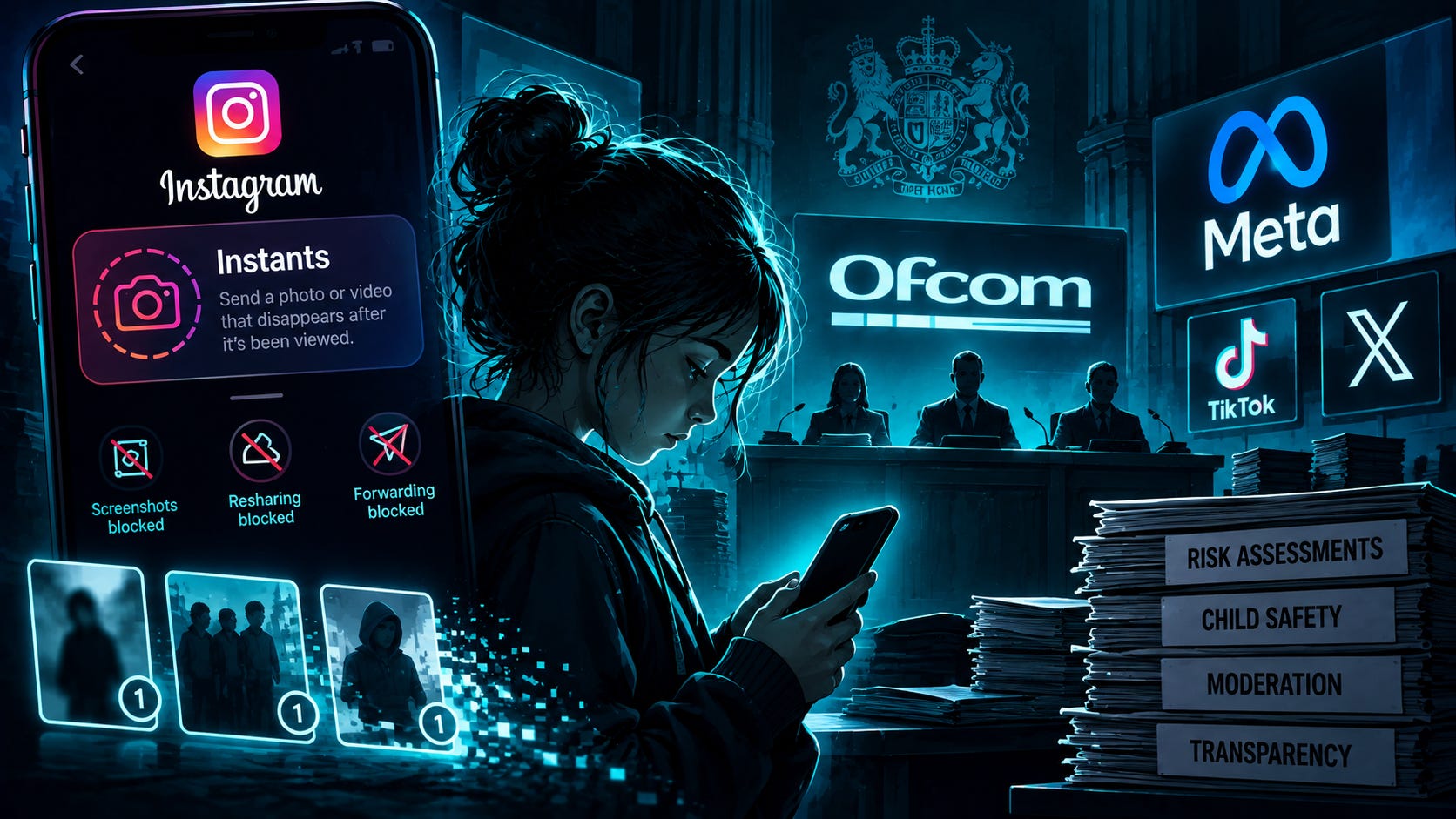
On 6 October 2026, Ofcom opened its first formal investigation under the Online Safety Act, with the target being Meta’s Instagram Instants feature. If you are a parent or teacher wondering what Instants is, why disappearing messages create risks for children and what you should actually do about it, this post will walk you through everything you need to know.
Instants launched on 13 May 2026. Five months later, the regulator is asking whether Meta properly assessed the risks to children before releasing it. That timeline alone should pique your interest.
What is Instagram Instants and how does it work?
Instants is a feature inside Instagram Direct that works like this: you take a photo or video in the moment (no camera roll uploads, no filters, no editing), send it to a friend, and once they view it, it vanishes. The content stays in the sender’s archive for up to a year, but the recipient sees it once, then it is gone.
If you have heard of Snapchat, you will recognise the concept. Disappearing content. View once, then it disappears.
Meta says Instants blocks screenshots, blocks resharing and blocks forwarding. They also say Teen Account protections are enabled by default. That sounds reassuring to most people on paper.
Why disappearing messages create real risks for children
Here is why I see it as a problem. It is just another feature that is going to be used by predators to enable sharing of content and it does not stop the recipient from recording the screen from another device.1
I spent eight years in digital forensics investigating cases involving children. I have seen what happens when evidence disappears by design. Disappearing messages do three things that made my job and the job of anyone trying to protect a child significantly tougher:
1. They erase the proof. If something goes wrong, the feature that felt private can make it much harder to demonstrate what happened.
2. They embolden bad actors. Someone using this feature to bully, coerce, or groom a child knows the evidence will vanish. That knowledge changes behaviour.
3. They shift the burden to the child. Without a record, you are relying on the witness statement of the victim with no evidence to back it up. That is an huge burden to place on a young person.
I would be interested to know if screen recording is disabled as well, but either way it is another way to release content with no controls over where it can go afterwards.
What Ofcom is actually investigating
The Online Safety Act requires platforms to carry out a “suitable and sufficient” illegal content risk assessment before launching new features. If children are likely to access the service, a children’s risk assessment is also required. A further assessment must be carried out if a significant change is made to the service.2
Ofcom, led by Director of Enforcement George Lusty, is examining whether Meta did that work before Instants went live.
Meta’s response? They say they take their obligations seriously, conducted a risk analysis and briefed Ofcom multiple times before launch.3
It is partly a defence. But telling the regulator about a feature is not the same as demonstrating that you assessed the risks to children and built adequate safeguards. Blocking screenshots does not stop someone pointing a second phone at the screen and pressing record.
The investigation in context
This investigation started in the same week that Meta, X, and TikTok asked the High Court to cut back the information Ofcom is demanding from them.4 Meta has also challenged Ofcom’s decision to place WhatsApp and Instagram in Category 1, the group of platforms with the strictest duties under the law, arguing some duties should not apply to private messaging. I ask you to draw your own conclusions about the timing.
If Meta is found to have broken the law, Ofcom can require them to take specific steps to become compliant and can impose fines of up to £18 million, or 10 per cent of worldwide revenue, whichever is greater.5 For a company the size of Meta, that is not a parking ticket.
⚡Please don’t forget to react & restack if you appreciate my work. More engagement means more people might see it. ⚡

What parents should do right now
The legislation is catching up to the technology, but then again, it always is. That means you cannot wait for the investigation to conclude before having conversations at home. Here is what I would do this week:
1. Have the conversation about disappearing messages
Your child may already be using Instants, or something like it on another platform. The pitch is appealing: send something, it vanishes, no trace. Children believe that. They do not understand that what they send can still be recorded using other devices or cameras.
Explain it simply. “Disappearing does not mean gone. Someone can always point another phone at the screen and record everything you send. Once you send it, you lose control of it.”
2. Ask what they would do if something felt wrong
This is not about catching them out. It is about making sure they know they can come to you when something does not feel right. The single most protective thing you can do is keep communication open, honest, and non-judgemental.
3. Check parental controls on Instagram
Teen Account protections are enabled by default, but defaults can be changed. Supervision settings in Instagram allow you to set time limits, see who your child is messaging (not the content, but the accounts), and receive notifications about new followers. It takes five minutes.
What teachers and DSLs should do right now
You are dealing with children on Instagram today, not in six months when the investigation concludes. Here is what matters for your setting:
1. Brief staff on what Instants is
Many staff will not have heard of it. A two-minute update in the next briefing, explaining what the feature does and why disappearing content complicates safeguarding, gets everyone on the same page.
2. Remind students that disappearing does not mean gone
In PSHE sessions, assemblies, or one-to-one conversations, the message is the same: someone can always record what you send using another device. The “disappearing” part gives a false sense of security.
3. Review your reporting pathways
If a child discloses something that happened via disappearing messages and there is no screenshot, what do you do? The answer is: you follow your existing procedures. A child’s account of what happened is evidence. Document what they tell you, word for word where possible. Advise them not to delete any messages they receive, as these can be used as evidence when reporting the perpetrator.6
4. Update your acceptable use policy if needed
If your policy references specific platforms or features, consider whether Instants (and similar disappearing content features) need to be addressed explicitly.
The bigger picture
This investigation is a test case. It is the first time Ofcom has used its formal enforcement powers under the Online Safety Act against a major platform. How it plays out will set the tone for everything that follows.
But here is what I want you to take away: the investigation does not change what you need to do at home or in school. Whether Meta conducted a sufficient risk assessment is a question for lawyers and regulators. Whether your child knows they can come to you when something feels wrong is a question for you.
As always, communication is the protective mechanism. A safe space for children to come to when something does not feel right. That is what works. That is what has always worked.

As always, thank you for your support. Please share this across your social media, and if you do have any comments, questions, or concerns, then feel free to reach out to me via the Social page, as I am always happy to spend some time helping to protect children online.
Remember that becoming a paid subscriber means supporting a charity very close to my heart and helping it do amazing things for people. Childline, I will donate 100% of paid subscriptions collected every six months, as I don’t do any of this for financial gain. Or to make a one-off donation, go to my Just Giving page.

If you or a child you know needs support:
Childline: 0800 1111 | childline.org.uk
Available 24/7, 365 days a year. Free, confidential, and here for every child.
Author’s professional assessment based on eight years in digital forensics and incident response, investigating criminal and inappropriate web browsing, including child abuse material cases.
Ofcom, “Investigation into Meta Platforms, Inc. in relation to Instagram,” 6 October 2026, ofcom.org.uk.
Meta spokesperson statement, reported in multiple outlets, October 2026.
High Court proceedings involving Meta, X, and TikTok challenging Ofcom information requests, October 2026.
Ofcom enforcement powers under the Online Safety Act 2023, ofcom.org.uk.
General child safety guidance on preserving evidence, consistent with advice from child protection organisations.