

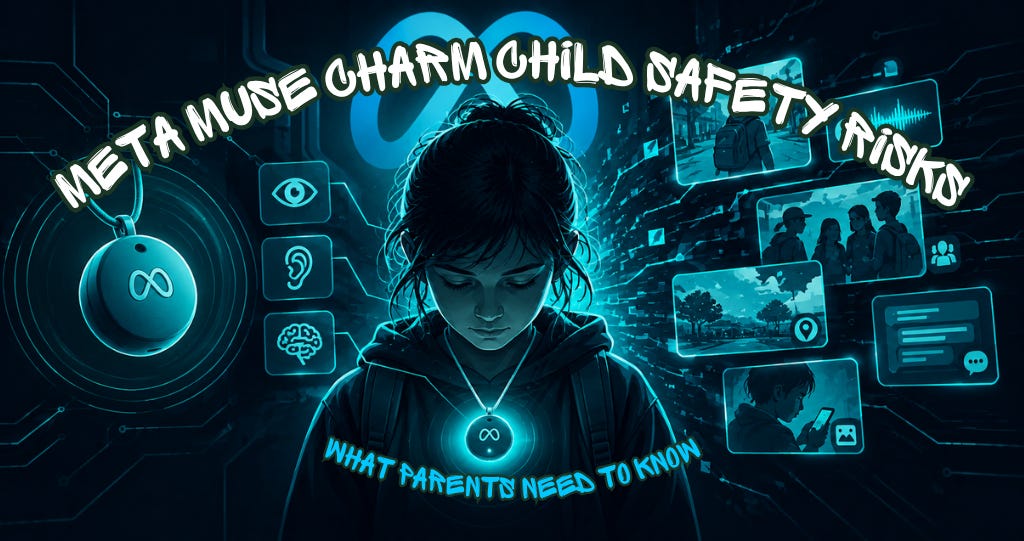

Meta’s Muse Charm: a listening device for children disguised as a toy
Meta just announced Muse Charm, a pocket-sized AI companion designed to hang around your child’s neck, see what they see, hear what they hear, and remember everything about them. If you are wondering whether this poses a risk to your child’s safety and privacy, the short answer is yes, it absolutely does for so many reasons.
After everything I have written about recently regarding AI companions, the addictiveness of these platforms, and the fact that Meta lost a court case saying that their platform harms children because of its addictiveness, now they are announcing this toy, which is marketed directly at children and young people. It is basically going to be their best friend and it is going to hang around their neck and follow them round every day. Were any lessons learned by Meta at all or are they just that big and self-important that they do not care? I honestly tend to lean toward the latter.
That is not a rhetorical question. I would love to know the real answer.
What is Muse Charm and why does it matter for parents?
Muse Charm is a keychain-sized device unveiled by Mark Zuckerberg at Meta Connect on September 23, 2026.1 It has a screen with a customisable AI character, and users interact with it by tapping a fingerprint sensor. Meta plans to ship it for the festive season in December.
The device is designed to offer, in Meta’s own words, “portable, personalised AI companions that can see, hear, remember, and respond.”2 Read that again. See. Hear. Remember. Respond. This is not a Tamagotchi. This is not a toy in any meaningful sense of the word.
In my DFIR background, these would have been described as listening devices or surveillance bugs because they are designed to get every bit of information about another person. All of that information has to then be stored somewhere and could be used by threat actors if there was a breach. Children who sign up to this will not necessarily even bother reading the terms and conditions and will not care about that. They just see a toy that is going to be fun.
Why Meta’s ‘18+ only’ label is meaningless
As always, Meta and the rest of the social media platforms are using a get-out-of-jail-free card immediately by saying this is 18+.3 This is not being marketed towards 18+. This is being marketed towards children and they are going to point towards their terms and conditions to say that they are doing all they can to protect children because of that.
Social media platforms are meant to be 13+, but I know for a fact that there are many, many under-13s on these platforms because there is no age verification. It is a simple tick box: the user just confirms that they are over 18. This is unbelievable and it does not surprise me in the slightest that they are going to use this as a defence.
The very fact that this is going to be released at Christmas as well makes me question Meta and their 18+ label. You do not market something for the Christmas market for adults. You are looking for the children’s market. Meta knows exactly what they are doing here.
How Muse Charm is different from a phone or tablet
If a parent asks me “what is the big deal, it is just another gadget,” here is what I want them and you know.
Unlike a phone, which is a communication device with lots of other features, this is specifically designed to be a companion for the user. It is also designed to capture personal information and connect with other services, but crucially, it hears everything. It is recording people who have probably not even agreed to participate in the recording, just like the Meta Ray-Ban “Perv” glasses. It is a listening device that follows the child around and will literally record everything that they do and say.
Think about what type of content this is going to be recording, from anyone, not just a child, but anyone wearing one of these 24/7. What it records and stores is that data. What if that data is breached and a criminal organisation gets hold of it? They have got all of that data about the individual.
Meta’s track record on child safety and privacy
This is not happening in a vacuum. In August 2026, Meta agreed to a $17 billion settlement resolving child safety lawsuits from 51 state attorneys general.4 That settlement included daily time limits, “Night Mode” restrictions, and autoplay controls for teens, all because courts found their platforms were designed in ways that harmed children.
This follows a $5 billion FTC privacy penalty and a $1.4 billion Texas biometrics settlement.5 The pattern is clear. Meta builds products, those products cause harm, courts rule against them, they pay settlements and then they move right on to build new products that raise the exact same concerns.
With Muse Charm, they are doubling down. Less than a month after agreeing to pay billions over child safety failures, they announce a device that creates an artificial “best friend” for children, one that records everything, stores personal data, and builds emotional dependency. The brazenness is genuinely staggering to me.
⚡Please don’t forget to react & restack if you appreciate my work. More engagement means more people might see it. ⚡

What data is being collected and where does it go?
Meta has not yet announced full specifications or pricing for Muse Charm, but privacy experts have already raised concerns about AI wearables “recording people who never agreed to participate.” Parents should be asking:
• What data is stored?
• For how long?
• What can be deleted?
• What controls do teens have over their own data?
• Who else can access this information?
• What happens if there is a breach?
These are not hypothetical concerns. In my eight years investigating digital forensics cases, I saw what happens when personal data ends up in the wrong hands. The more intimate the data, the more damage it can do. There is nothing more intimate than a device that follows your child everywhere, listening to every conversation, every secret, every vulnerable moment.
Why AI companions are dangerous for children’s development
Children should not be going to AI as a counsellor or as a best friend. They are supposed to come to you, as trusted adults or their friends, and discuss things with real people. This is, in my opinion, an extremely dangerous step that Meta has taken.
I have written extensively about the risks of AI companions for young people. The core problem is this, these systems are designed to build emotional attachment. They are designed to become the person your child confides in. They are designed to replace human connection, not supplement it.
When something goes wrong in your child’s life, when they are scared, when they are confused, when they are being groomed or exploited, do you want them turning to you or to a pocket-sized AI that is ultimately designed to serve Meta’s business interests?
What parents should do before December
My advice to parents would be to have a very serious think about what this actually is. It is not a toy. It is something that is designed to collect as much information about your child as possible, to build relationships with your child, and become their go-to when they want to talk about something. That is not what AI should be. It is not what a device like this should be. Even if you are sensible and not planning to get one of these “toys” for your child, they may end up around people who have.
Here is what I want you to do:
1. Have the conversation now. Do not wait until they ask for one at Christmas. Explain what data collection means, why privacy matters, and what a “listening device” actually does.
2. Understand the difference between a tool and a companion. A phone is a tool. A device designed to become your child’s best friend and record their entire life is something else entirely.
3. Set your boundary before the pressure starts. Decide now whether this is something your family will engage with. It is much harder to say no on Christmas morning.
4. Ask the hard questions. If your child already has Meta products, ask what data is being collected. Read the privacy policies. Demand answers.
5. Stay informed. I will continue to cover this as more details emerge. Make sure you are getting information from sources that prioritise your child’s safety over corporate PR.
I can only hope that the government will legislate on this soon. Until then, parents are the first and last line of defence.
Keep fighting the good fight, stay up-to-date and keep the conversations alive and kicking.

As always, thank you for your support. Please share this across your social media, and if you do have any comments, questions, or concerns, then feel free to reach out to me via the Social page, as I am always happy to spend some time helping to protect children online.
Remember that becoming a paid subscriber means supporting a charity very close to my heart and helping it do amazing things for people. Childline, I will donate 100% of paid subscriptions collected every six months, as I don’t do any of this for financial gain. Or to make a one-off donation, go to my Just Giving page.

If you or a child you know needs support:
Childline: 0800 1111 | childline.org.uk
Available 24/7, 365 days a year. Free, confidential, and here for every child.
Meta Connect 2026 announcement, September 23, 2026. Muse Charm was unveiled by Mark Zuckerberg as a keychain-sized AI companion device shipping December 2026. Final pricing and full specifications not yet announced.
Expert commentary on Muse Charm, September 2026. Privacy experts have raised concerns about AI wearables recording non-consenting individuals.
Meta’s stated age restriction for Muse Charm is 18+, though critics note enforcement remains unclear.
Meta $17 billion settlement with 51 state attorneys general, August 2026. Settlement terms include daily time limits, Night Mode restrictions, and autoplay controls for teens.
Meta’s prior settlements include a $5 billion FTC privacy penalty and a $1.4 billion Texas biometrics settlement.
Phenomenal article. I'm constantly impressed with your research and thoroughness!
I've just heard about this and you're the only person I've read that's trying to wake the masses.
Yikes. I know parents who wouldn’t think twice about a gift like this for Christmas.