

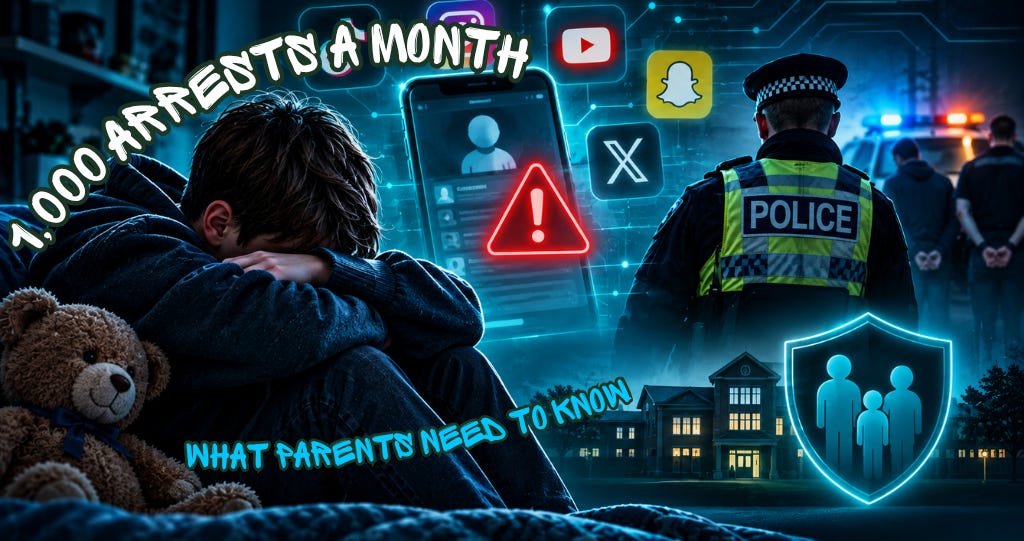

Police are arresting 1,000 people a month for online child sexual abuse. Here’s what parents and schools need to understand.
Every month, police in England and Wales arrest around 1,000 people, mostly men, for online child sexual abuse offences. That figure alone should tell you the scale of what we’re dealing with. Worse than that was the admission that came alongside it: forces are overwhelmed, turning to charities for help and openly saying they don’t have the resources to handle this alone.
The scale of the problem and why we’re not keeping up
According to an April 2026 report from His Majesty’s Inspectorate of Constabulary and Fire & Rescue Services (HMICFRS), police forces across England and Wales are struggling to effectively investigate online child sexual abuse as rising demand continues to exceed resources1. The number of arrests is climbing, but the capacity to investigate, intervene, and support is not climbing with it.
It should let people see the scale of the problem. It should also show that the government hasn’t resourced the police and other organisations enough to combat this, including the education side of things. I still believe that education on all topics around online safety should be part of the national curriculum, with the level and standard of that content not being decided at the school level, but provided as part of a Subject Matter Expert (SME) curated programme that is part of the national curriculum. Instead, governments keep relying on what they call “mandatory guidance”, which was just one of the replies I have previously received from a SoSfE.


Mandatory guidance sounds robust until you realise what it means in practice: a postcode lottery where one teacher might be brilliant at creating content and delivering it, while another school’s teachers are left struggling with no training and no support.
How desensitisation works and why ‘it’s just porn’ is dangerous thinking
Officers investigating these offences describe men who became desensitised to extreme pornography and escalated over time. Many of those now being arrested as adults started viewing this material as teenagers2. The Lucy Faithfull Foundation, which runs the Stop It Now helpline, reports that thousands of callers cite extreme pornography in their path toward viewing illegal images3.
I’m not saying pornography causes abuse, as that’s not what the evidence shows. What officers and charities are describing is a pattern of escalation, a wearing down of normal responses over time.
Exactly like grooming, this is where your ability to recognise danger is worn down over time. It’s an issue that affects all humans. The more they see something, the more it becomes part of a normal routine or the normal day, no matter how horrific or horrendous it might be. Parents need to be fully aware of these risks so that they can make sure their children never become desensitised to these types of things and should always be horrified by them.
Over time, just like with other offending behaviour, individuals escalate the level and seriousness. It’s the same with the viewing of material. It just gets more and more extreme, the longer they are able to view it and the more they view it. I agree fully with what the Lucy Faithfull Foundation and the police are saying publicly about this.
Why civilian interventions for teenagers make sense
Police forces are now considering pilot programmes where civilian specialists would visit children who view illegal material, following the successful Solah project in Surrey. Officers have been explicit, they do not seek to criminalise children if there are no aggravating circumstances4.
Some people will say that’s going soft. Others will say any intervention ruins a kid’s life.
I actually believe this is the correct course of action in some respects. But I don’t think it should be for the police to be doing this education. As I’ve said before, I think this education should start as early as possible in schools as part of the national curriculum, with content produced by SMEs and delivered at schools to the same standard.
The goal has to be reaching children before they ever access this material, not scrambling to intervene after they already have.
⚡Please don’t forget to react & restack if you appreciate my work. More engagement means more people might see it. ⚡

What the new law changes mean
The Crime and Policing Act 2026, which came into force in November, introduces two significant changes5:
First, it is now a criminal offence to make, possess, supply, or offer to supply AI image generators that create images of child sexual abuse material (CSAM). This closes a gap that has allowed synthetic abuse material to proliferate.
Second, the Act introduces a mandatory duty on teachers, healthcare workers, and others to report suspected child sexual abuse. This formalises what many professionals already understood as their moral obligation, but now carries legal weight.
Platform accountability is coming, but it’s not here yet
Child safety duties under the Online Safety Act came into force in July 2025. In July 2026, Ofcom opened an investigation into TikTok to assess compliance with child protection duties, including age assurance measures6.
But, the full framework of platform duties is still being developed. App store reports are due in January 2027, with final policy statements on additional duties expected mid-2027. We are still waiting to see how effectively these measures will be enforced.
What parents and DSLs should actually do
If you’re a parent or safeguarding lead reading this and thinking “I need to have a conversation with a teenager but I don’t know how to start without accusing them or making it worse,” here’s my advice.
Use the media stories that have already been published on this topic. Say that you’ve read something about it and ask what your child thinks. Then have a discussion about why these things are illegal and the effect they have on people, not just the victims in the actual content, but the people who view it and how it affects them and their mental health going forward.
You should definitely avoid punishing a child for this. Punishment means they are very unlikely to come to you in the future if something worries them and they need to approach a trusted adult.
Warning signs that something might be wrong
1. A sudden increase in secrecy around devices, clearing browser history obsessively, or becoming agitated when asked about online activity
2. Withdrawal from family, friends, or activities they previously enjoyed
3. Changes in sleep patterns, particularly staying up late when they assume no one is monitoring
4. Expressing views that minimise the seriousness of sexual content or victim-blaming language
5. Evidence of accessing the dark web or using VPNs without a clear, legitimate reason
None of these signs alone mean a child is viewing illegal material. But they are indicators that something has shifted and that a conversation is needed.
Where a worried child or teenager can get help
If you are a young person worried about your own or someone else’s sexual thoughts, feelings, or behaviour, Shore is a resource specifically designed for teenagers aged 13-18. It offers live chat, email support, and self-help resources. You do not have to give your name.
Childline (0800 1111) is available 24 hours a day for any child or young person who needs to talk, about anything.
If you’re an adult with concerns, the Stop It Now helpline (0808 1000 900) offers anonymous, confidential support.
To report illegal images, contact the Internet Watch Foundation.

As always, thank you for your support. Please share this across your social media, and if you do have any comments, questions, or concerns, then feel free to reach out to me via the Social page, as I am always happy to spend some time helping to protect children online.
Remember that becoming a paid subscriber means supporting a charity very close to my heart and helping it do amazing things for people. Childline, I will donate 100% of paid subscriptions collected every six months, as I don’t do any of this for financial gain. Or to make a one-off donation, go to my Just Giving page.

If you or a child you know needs support:
Childline: 0800 1111 | childline.org.uk
Available 24/7, 365 days a year. Free, confidential, and here for every child.
HMICFRS, “Online child sexual abuse: An inspection of police forces’ response,” April 2026. This report found that rising demand continues to exceed resources across England and Wales.
The Guardian, “Police arrest about 1,000 people a month for online child sexual abuse offences,” 6 November 2026. Officers described patterns of men becoming desensitised to extreme pornography, with many young adults who started as children and escalated over time.
Lucy Faithfull Foundation, Stop It Now helpline data, reported in The Guardian, 6 November 2026.
Police statements regarding the Solah project pilot and approach to children who view illegal material, November 2026.
Crime and Policing Act 2026, provisions on AI-generated child sexual abuse material and mandatory reporting duties, in force November 2026.
Ofcom, TikTok investigation announcement, July 2026; Online Safety Act child safety duties in force July 2025; app store reports due January 2027.