

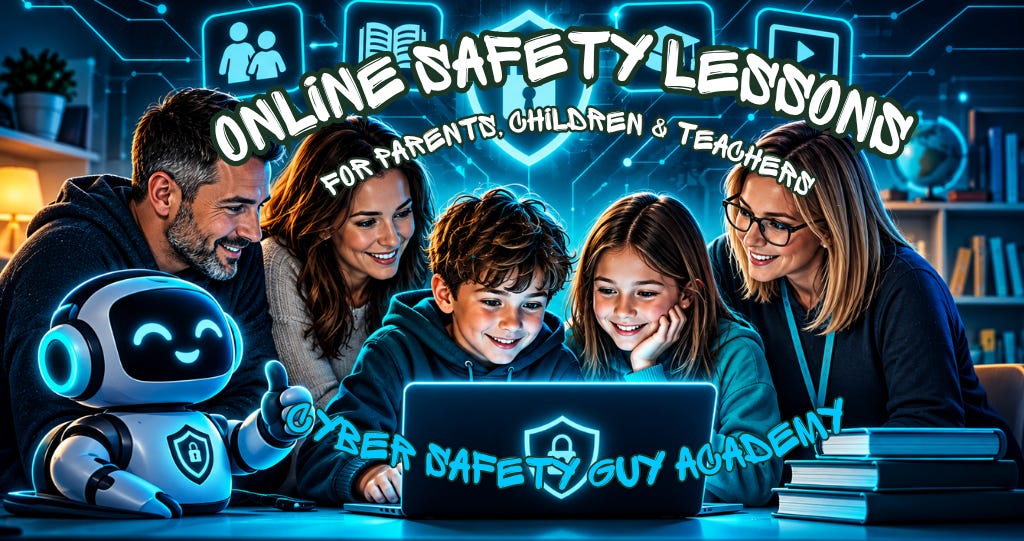

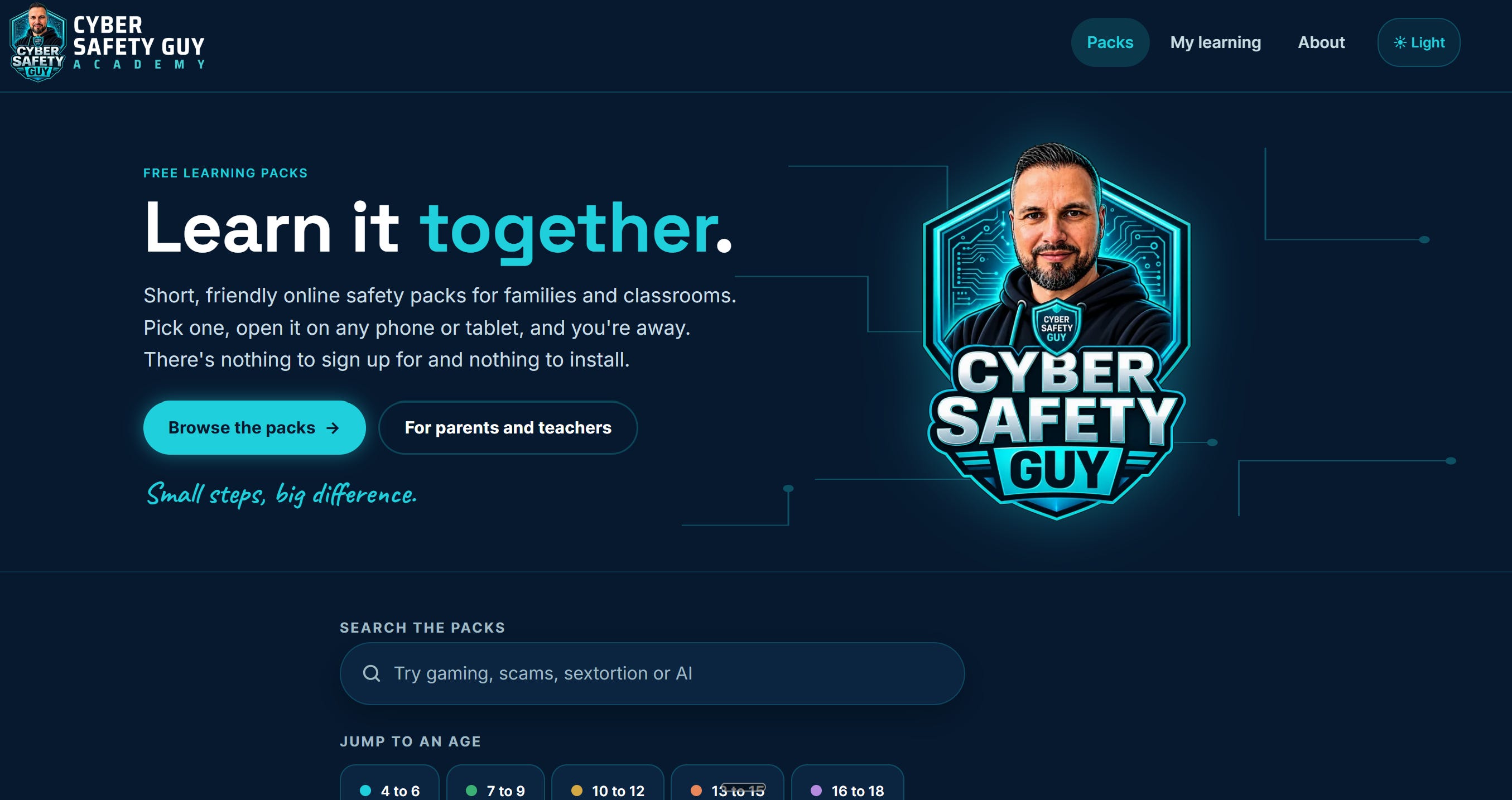
Online safety lessons for children work best when they happen at home and at school, side by side. Today I’m launching Cyber Safety Guy Academy: free online safety packs for children aged 4 to 18, with guides for the parents and teachers sitting next to them. There are also specific guides for parents and teachers.
It’s free, there’s nothing to sign up for, and nothing your child does on it ever leaves your device. You’ll find it at academy.cybersafetyguy.com.
Why I built a free online safety academy for families and schools
I spent too many years looking into the eyes of children who were victims of abuse, and I will spend the rest of my days doing anything I can to prevent another child from becoming a statistic of that very dark world.
I previously tried to have online child safety put on the national curriculum, created and curated by subject matter experts. Two separate Secretaries of State for Education said there was no need, as there is statutory guidance in place. The issue with that is there is a postcode lottery of the standard of the education delivered, as it will depend on the capabilities of each school to create and deliver that content.
I am also aware that many parents don’t know where to even start when it comes to the current technological trends, risks and apps. So I felt that an evolution for my Cyber Safety Guy platform was to add this as a central repository for parents, teachers and the children to learn about what is important, in a jargon-free way that people understand.
What parents say about online safety conversations at home
Ofcom’s latest research on children and parents, published in May 2026, shows how many families are already trying. Two-thirds of parents (66%) say they talk to their child about staying safe online at least every few months, but 13% say they have never had that conversation at all.1
Only around a third of parents (32%) know that 13 is the minimum age for most social media platforms, and half (51%) either give the wrong answer or don’t know. Two-thirds (66%) worry about whether their child can tell what is real or fake online.
From everything I witnessed in digital forensics, the most powerful parental control of all is one that every person already has, non-judgmental communication, early and often, with their child, letting them know that you are a safe space for them when they feel something is not right. Parents don’t need to be tech geeks to protect their children. They just need to be the person that child will talk to.
Online safety packs for every age, from 4 to 18
The Academy opens with 31 packs across five series:
Understanding AI
Scams and Money
Kind Online
Healthy Relationships
Online Grooming and Sexploitation
Each series has short packs for the ages it covers, plus a pack for parents and a pack for teachers. They work on a phone, a tablet or a classroom screen, and most take between 12 and 35 minutes.
Every helpline, law and curriculum link in the packs is checked against official sources such as gov.uk and legislation.gov.uk, and each one is labelled with the part of the UK it applies to.
Byte’s HQ: online safety for younger children aged 4 to 9
Younger children get Byte, a robot sidekick who lives in a little den. Every pack they finish adds something to it: a new piece of gear for Byte, a shield on the wall. There are no streaks and no timers, and Byte never loses anything if they take a break.
The analyst profile: teaching teens to spot scams, fakes and manipulation
Children aged 10 to 18 get an analyst profile instead, with skills such as Scam Radar and Deepfake Detection, capture-the-flag challenges where they find the giveaways in a fake text or put a sextortion script in the right order, patches to collect, and career cards about real jobs in cyber security.
Ofcom found that 56% of 8 to 17-year-olds have used AI, rising to 66% of 16 to 17-year-olds, and that some accept what it tells them without checking the sources.
Children are not stupid, and in some respects they are far more switched on to the technical world we live in these days. So in my honest opinion it is better to give them as much information about the risks as possible, so that they can make that information part of their decisions. I certainly recall that being told “don’t do that” with no extra context always just made me think maybe I should do that!
I also want them to know that having knowledge of these skills is actually something that you can make a career of. I always thought that my youth as a geek was going to be misspent, but look at me now!
⚡Please don’t forget to react & restack if you appreciate my work. More engagement means more people might see it. ⚡

Private by design: no accounts, no tracking, no data collected
There are no accounts and no tracking on the Academy. Progress is saved in the browser on the device being used, and nothing is sent back to me. Since 25 July 2025, Ofcom’s Protection of Children Codes have put legal duties on online platforms to protect children and unlike the platforms I often write about, that is my priority.2
I have no trust in what platforms do with the data they hold, and I also know how devastating a data breach can be when it occurs. I have no need to collect the data of people who use my platform, because I don’t look to make any profit from what I do. If people want to, they have the option to sign up to my newsletter, but that only requires their email address and they can all decide on the benefits of doing so.
Online safety lessons for teachers and DSLs
Every series has a teachers pack with a session guide and a printable staff briefing. The packs line up with the Department for Education’s relationships, sex and health education guidance in force from September 2026, which now names sextortion,3 and with Keeping Children Safe in Education 2026.4
I give my time and effort to this mission for only one thing. It isn’t for money, recognition or awards. It is only to try and make sure that parents and teachers have any and all information available to them to protect children. If they have questions, then I am there to answer them, as I would rather spend time answering a question than for them to not understand something and for a child to be put at risk.
I am working with organisations right now who don’t have information and are genuinely surprised that I want to offer help for free. I wish it were not necessary, and that the Government would accept my recommendations regarding the National Curriculum, but until such time as that happens, I will continue to develop the Cyber Safety Guy mission.
How to start an online safety conversation with your child tonight
If you do one thing after reading this, ask your child this:
“I want to learn more about the online world, what can you teach me?”
Children know far more about the world they are part of, and if they think they are the teacher, they will open up. That conversation can genuinely kick-start more regular conversations. It isn’t about having one large conversation but lots of normal, regular ones.
Then pick a pack and open it together at academy.cybersafetyguy.com

As always, thank you for your support. Please share this across your social media, and if you do have any comments, questions, or concerns, then feel free to reach out to me via the Social page, as I am always happy to spend some time helping to protect children online.
Remember that becoming a paid subscriber means supporting a charity very close to my heart and helping it do amazing things for people. Childline, I will donate 100% of paid subscriptions collected every six months, as I don’t do any of this for financial gain. Or to make a one-off donation, go to my Just Giving page.

If you or a child you know needs support:
Childline: 0800 1111 | childline.org.uk
Available 24/7, 365 days a year. Free, confidential, and here for every child.
Ofcom, Children and Parents: Media Use and Attitudes Report, published 21 May 2026. https://www.ofcom.org.uk/siteassets/resources/documents/research-and-data/media-literacy-research/children/2026-children-and-parents-report/children-and-parents-media-use-and-attitudes-report-2025-6.pdf (accessed 9 November 2026)
Ofcom, Protection of Children Codes of Practice, issued 4 July 2025, in force 25 July 2025. https://www.ofcom.org.uk/online-safety/protecting-children/new-rules-for-a-safer-generation-of-children-online (accessed 9 November 2026)
Department for Education, Relationships Education, Relationships and Sex Education and Health Education statutory guidance, in force from 1 September 2026. https://www.gov.uk/government/publications/relationships-education-relationships-and-sex-education-rse-and-health-education (accessed 9 November 2026)
Department for Education, Keeping Children Safe in Education 2026. https://www.gov.uk/government/publications/keeping-children-safe-in-education--2 (accessed 9 November 2026)
This is amazing, Dale! Thank you!