

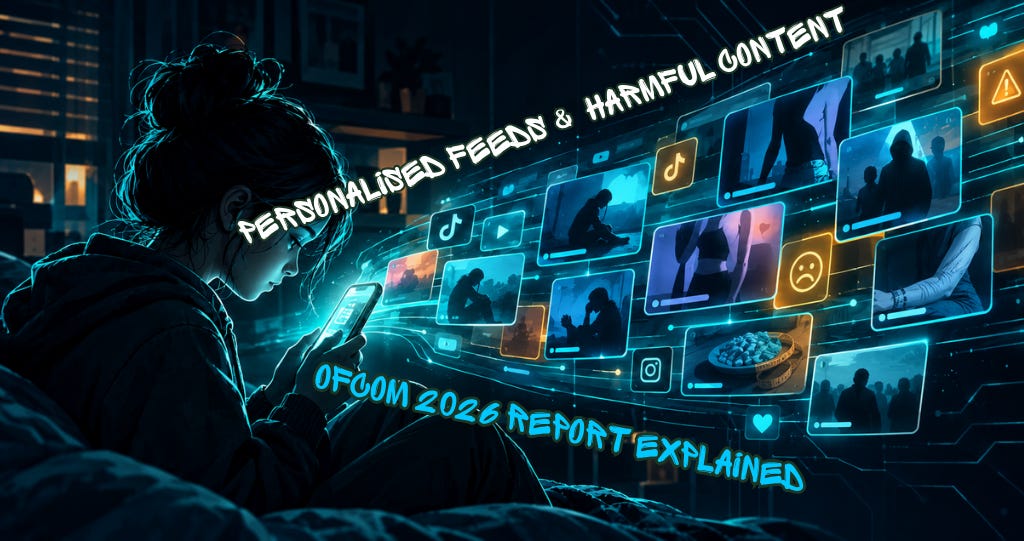

Why your child’s feed is the biggest online safety risk in 2026
Ofcom’s first statutory report under the Online Safety Act was published on 22 October 2026, and it tells us something parents need to hear: a full year after child safety duties came into force, there has been no significant drop in the proportion of UK children encountering harmful content online.1 According to Ofcom’s May 2026 data, around 73% of 11 to 17-year-olds recalled being exposed to at least one piece of harmful content in a four-week period.2 The problem is not isolated bad posts. The problem is the feed itself.
I spent 8 years in digital forensics investigating child abuse material. I analysed more than 1 million images, approximately a quarter of which were criminal. I had no counselling or therapy support during that work and was eventually diagnosed with Complex Post-Traumatic Stress Disorder (CPTSD). I was medically discharged from the RAF in 2019. Every piece of content I create now takes a personal mental and physical toll because of the triggering effects, but if it protects even one child, it is worth the pain, especially if my pain can be a shield for your children.
When I saw those Ofcom numbers, one thought went through my head: platforms are continuing to ignore the legislation. Until they are brought through the court system, like Meta in the United States, they will continue to do so. Until it really harms their bottom line, they will put out the PR message that they are doing what needs to be done, but clearly these figures show that is not the case.
Why the personalised feed is the danger, not just individual posts
Here is the statistic that should change how you think about online safety: 35% of 11 to 17-year-olds reported encountering harmful content while scrolling their feeds, against only 1% who searched for it.3
Let me put that in plain terms. Children looking for this content is not the issue, as the figures show. The issue is that they are being served this kind of content without actively seeking it. It is like going for a walk in the park because you want to see nature, and every 2 seconds somebody jumps out of the bushes trying to scare you. That is the effect it has on these children, as they are just trying to use the platform for their enjoyment.
The feed is not a neutral window into content. It is a machine designed to hold attention and an algorithm does not distinguish between curiosity and distress. If a child lingers on a post about body image, the algorithm reads that as interest. It serves more. If they watch a video about self-harm all the way through because they are worried about a friend, the algorithm reads that as engagement. It serves more.
The October 2026 report confirmed via ITV that 14% of 11 to 17-year-olds said they were exposed to suicide or self-harm content in the previous four weeks, while 23% said they had seen eating disorder content.4 These are not fringe figures. This is nearly a quarter of children seeing content that could shape how they think about their own bodies and their own lives.
The TikTok investigation: what it means and what it does not
Ofcom opened an investigation into TikTok on 16 July 2026 to examine compliance with section 12 duties under the Online Safety Act.5 Specifically, Ofcom raised serious doubts about TikTok’s ability to identify when a user is under 18, with evidence suggesting age inference methods may be failing to correctly detect significant numbers of children.6
TikTok has responded by saying it strictly enforces age-appropriate experiences through expert-informed platform rules and advanced age inference technologies.7
That sounds like excellent PR language, although I would like to see what the actual details are. Clearly Ofcom have seen them and cast serious doubts over whether they can actually tell who is under 18.
Age verification is one of the most difficult aspects of online child safety at the moment and one that still needs to be strengthened and verified. It is also one of the most contentious points with privacy campaigners, who see any advancement in this area as an issue, which just allows the platforms to drag their heels even more.
Opening an investigation does not mean Ofcom has reached any conclusion.8 But if failures are found, fines could reach £18 million or 10% of qualifying worldwide revenue.9 Platforms will only react to pressure being brought to bear against them which causes reputational damage and incurs very real fines that are not the equivalent of their yearly paperclip budget.
⚡Please don’t forget to react & restack if you appreciate my work. More engagement means more people might see it. ⚡

Algospeak: the coded language your child already knows
If you have heard your child say “unalive” instead of “dead” or “SA” instead of “sexual assault,” you have encountered algospeak. It is a self-censorship phenomenon where users adopt coded expressions to evade content moderation.10 It allows users to discuss topics deemed sensitive while avoiding penalties such as shadow banning or downranking.

Pro-eating disorder communities have used coded language and avoided hashtags as an evasion strategy to bypass content moderation.11 The language shifts constantly, which is precisely the point.
Here is what I want parents to understand: there is nothing new in the slang and jargon that teens and young children are using these days. “Unalive” is just the most recent way of saying suicide, but fully understanding the language and the jargon is not what you need to be concerned with.
You should ensure that you are having good communication with your children and providing a safe space at home. When something goes wrong, they can approach you and tell you without fear of being punished. Punishment and taking the phone off the child are the one thing that will stop them from ever coming to you in the future and they will keep things secret.
Sexual predators thrive on secrecy.
Do not believe you need to be a tech expert because it is just not required, even I do not understand half the language they use.
What parents can do this weekend
Only 15% of children told an adult about harmful content, up from 10% at Wave 1, driven predominantly by girls at 20% and 11 to 12-year-olds at 21%.12 That means 85% of children who saw something harmful kept it to themselves.
This just reinforces what I said about making sure that you are a trusted adult that they know they can come to when something goes wrong, because it will go wrong. It is in that moment that you need to know they will come to you. There is a reason why I call the internet the Wild West and try to portray the many dark corners that exist on it. You cannot protect them from everything. You just need to know that they will come to you if something feels off to them.
Here is what you can do:
1. Talk first. Not a lecture. A conversation. Ask them what they have seen that made them feel uncomfortable. Listen without judgement. Do not reach for the phone.
2. Reset feeds together. Most platforms allow you to clear recommendations and start fresh. Sit with your child and do it together. It is not a punishment, it is maintenance, like clearing out a cluttered room.
3. Report together. If they show you something harmful, walk through the reporting process with them. They learn how to act, and they see you taking it seriously without panicking.
4. Do not share. Screenshots of harmful content, even to warn other parents, can spread the harm further. Report it to the platform and to the relevant authorities if needed, but do not amplify it.
The irony that the creators of these platforms will not let their own children use them says it all.

A note for designated safeguarding leads
If you work in a school or youth setting, the Ofcom report has direct implications for your safeguarding conversations. The data on personalised feeds means that a child does not need to be actively seeking harmful content to be exposed to it. This changes the questions you ask when a disclosure happens.
Consider updating your training to reflect that feed-based exposure is now the primary route to harm, not search. And if you are seeing an increase in disclosures related to self-harm or eating disorders, the 14% and 23% figures from Ofcom give you the evidence base to escalate concerns to leadership and governors.

As always, thank you for your support. Please share this across your social media, and if you do have any comments, questions, or concerns, then feel free to reach out to me via the Social page, as I am always happy to spend some time helping to protect children online.
Remember that becoming a paid subscriber means supporting a charity very close to my heart and helping it do amazing things for people. Childline, I will donate 100% of paid subscriptions collected every six months, as I don’t do any of this for financial gain. Or to make a one-off donation, go to my Just Giving page.

If you or a child you know needs support:
Childline: 0800 1111 | childline.org.uk
Available 24/7, 365 days a year. Free, confidential, and here for every child.
Ofcom, “First Statutory Report on Content Harmful to Children,” October 2026. Accessed October 2026. This is Ofcom’s first report under section 63 of the Online Safety Act 2023.
Ofcom tracker data, May 2026. The 73% figure refers to 11-17 year olds recalling exposure to at least one piece of harmful content in a four-week period.
Ofcom, October 2026 report. The contrast between 35% feed exposure and 1% search exposure is directly from the statutory report.
ITV News coverage of Ofcom report, October 2026. These figures are from Ofcom data but were verified via ITV reporting.
Ofcom announcement, 16 July 2026. The investigation relates to section 12 duties under the Online Safety Act.
Ofcom, July 2026. The phrase “serious doubts” is directly from Ofcom’s public statement regarding the investigation.
TikTok statement in response to Ofcom investigation, 2026.
Ofcom guidance on investigations. Opening an investigation is a procedural step, not a finding of breach.
Online Safety Act 2023, penalty provisions. Maximum penalties are £18 million or 10% of qualifying worldwide revenue, whichever is higher.
Definition of algospeak from verified research on social media content moderation evasion.
Research on pro-eating disorder community evasion tactics, 2026.
Ofcom tracker data, October 2026. The increase from 10% to 15% is across the two waves of research following the Online Safety Act duties coming into force.