

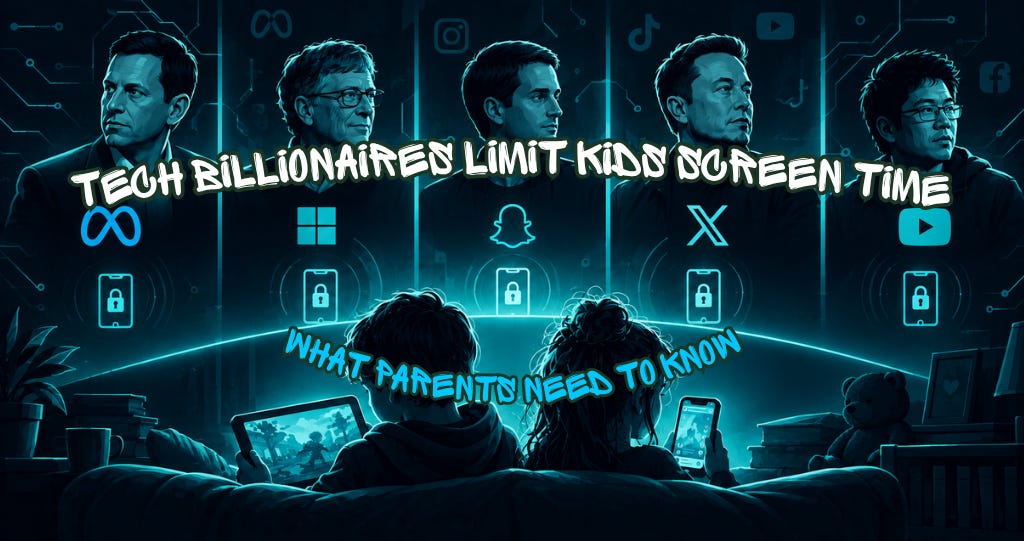

Why the people who built social media won’t let their own children use it
Peter Thiel, one of Facebook’s earliest investors and a co-founder of PayPal, lets his children have ninety minutes of screen time per week. Not per day. Per week. When he said that at the 2024 Aspen Ideas Festival, the audience literally gasped.1
That gasp was the sound of a penny dropping. The people who built the most addictive platforms on the planet are keeping their own children away from them. So, if you are a parent who was wondering whether you are being paranoid about screen time, this is your answer.
The pattern is too consistent to ignore
Thiel is not an outlier. Bill Gates did not give his children smartphones until they were fourteen, and phones were banned at the dinner table.2 Evan Spiegel, the man who runs Snapchat, gives his two-year-old almost zero screen time, and his older children rarely touch screens and do not have phones.3 Elon Musk has publicly acknowledged that failing to set rules around his children’s social media use may have been a mistake.4 Steve Chen, who co-founded YouTube, has warned that short-form content creates shorter attention spans and suggested parents stick to videos longer than fifteen minutes.5
These are not tech-sceptic parents reading scaremongering articles. These are the architects. The people who understand exactly how the algorithms work, how the engagement loops are designed, and what the data shows about young users. They know what the product does and they are not letting their children near it.
When I see that one of the people responsible for Facebook, a platform recently fined huge sums of money for being addictive and harmful to children, has limited his children’s screen time but hugely benefited financially from enabling the opposite of that with other children, that says everything you need to know about these people and their business models and the fact they know the negative effect it is having on children.
What they know that most parents don’t
The business model of these platforms is simple: keep users engaged and hooked for as long as possible and they make more money. They do not care if that user is a child or an adult, but they are very aware of the harm it causes children. Hence, they do not allow their own children to use them. I think this says a lot about the platforms themselves and should have caught the attention of every parent.
I have seen how these platforms collect data, how they profile users, and how the design choices that keep adults scrolling have far more serious consequences for developing brains. The tech founders limiting their children’s access is not hypocrisy for its own sake. It is an endorsement of the warnings that I and others have been giving for many years now. The warnings have always been valid because they came from people who have seen what happens when children get drawn onto these platforms with very few guardrails in place.
Why short-form content is not just annoying, it is developmental
Steve Chen’s warning about short-form video deserves particular attention. Ofcom data shows children in the UK are spending nearly three hours online every day, with teenagers spending at least two of those hours on social media alone.6
Here is why that matters for your child’s brain:
The part of the brain responsible for patience, focus, and sticking with difficult things, the prefrontal cortex, is still being built during childhood and adolescence. It does not finish developing until the mid-twenties. What children repeatedly experience during that window shapes what feels normal to them.
Short-form content is designed to deliver a reward every few seconds. A laugh, a surprise, a jump cut. The brain learns to expect that. And when it does not get it, when a task is slow, or a book takes effort, or a conversation does not move quickly enough, the brain starts treating that as something to escape rather than push through.
It is not that the videos are making your child stupid. It is that patience is a skill, and skills need practice. Every hour on Shorts or TikTok is an hour that skill is not being built.
⚡Please don’t forget to react & restack if you appreciate my work. More engagement means more people might see it. ⚡

The legislative reality is catching up, but slowly
Here in the UK, the Online Safety Act is now in force. Ofcom has issued enforceable codes of practice that platforms are legally required to comply with, including robust age verification and stronger protections for children and young people. The Government has also announced a social media ban for under-16s, with Ofcom’s chief executive writing directly to the Secretary of State to set out how that would work in practice.7 Platforms that fail to meet these standards face significant fines.8
That is real progress, and I do want to recognise that. People worked hard to get the Online Safety Act passed, and it is work like that which will ultimately get us to where we need to be.
But, the age checks are still being worked out. The platforms have entire legal teams whose job is to find the gap between what the law says and what they actually have to do and the history of tech regulation tells us that by the time legislation catches up with one harm, the next one is already running unchecked somewhere else.
Legislation will always lag behind technology. That is not a criticism of the people writing the laws. It is just how this works. We are moving towards a time when platforms will be held properly accountable for the safety of children. We are not there yet.9
What you can actually do this week
You do not need to wait for politicians to sort this out and you do not need to worry that you are not a tech expert.
Parents should noit be expected to be tech experts. They need to understand that the platforms are inherently risky for children, so just communicate with your children and let them know that you are a safe space where they can come anytime something does not feel right.
I am here to be the technical expert and explain things in a jargon-free way. But you have the ultimate parental control in your toolkit, talk to your child, that is better than any technical control.
Three things you can do right now:
1. Audit screen time honestly. Not what you think happens, what actually happens. Most phones have built-in screen time tracking. Look at the numbers together with your child, not as a punishment, but as a conversation starter.
2. Ask one question at dinner. “What’s something you saw online today that made you feel uncomfortable, or that you didn’t quite understand?” Then listen without reacting. The goal is to become the person they come to, not the person they hide from.
3. Model the behaviour you want. If you are checking your phone during conversations, you are teaching them that is normal. Put it away. Let them see you choose them over the screen.
The tech billionaires are not smarter than you. They just have information you did not have until now. They know what these platforms do to developing brains, and they are protecting their children accordingly.
Now you know too.

As always, thank you for your support. Please share this across your social media, and if you do have any comments, questions, or concerns, then feel free to reach out to me via the Social page, as I am always happy to spend some time helping to protect children online.
Remember that becoming a paid subscriber means supporting a charity very close to my heart and helping it do amazing things for people. Childline, I will donate 100% of paid subscriptions collected every six months, as I don’t do any of this for financial gain. Or to make a one-off donation, go to my Just Giving page.

If you or a child you know needs support:
Childline: 0800 1111 | childline.org.uk
Available 24/7, 365 days a year. Free, confidential, and here for every child.
Aspen Ideas Festival, 2024. Peter Thiel stated his children have 90 minutes of screen time per week, prompting an audible audience reaction.
Various interviews with Bill Gates, widely reported. Gates has confirmed his children did not receive smartphones until age 14 and that phones were banned at meals.
Evan Spiegel interviews, multiple outlets. Spiegel has discussed his graduated approach to screen time based on a child's age.
Elon Musk public statements and interviews, acknowledging regret about social media rule-setting for his children.
Steve Chen interview, warning that “shorter-form content equates to shorter attention spans” and recommending videos over 15 minutes.
https://www.expressandstar.com/news/science/children-spending-average-of-nearly-three-hours-online-a-day-ofcom-data-reveals-5649476
UK Government and Ofcom, 2026. The Government announced plans for a social media ban for under-16s. Ofcom’s chief executive Dame Melanie Dawes wrote to the Secretary of State for DSIT setting out Ofcom’s position on implementation.
Ofcom, Online Safety Industry Bulletin, March 2026. Platforms failing to comply with the Online Safety Act’s codes of practice face fines of up to ten per cent of global annual turnover.
Ofcom Online Safety Act enforcement updates, 2025 and 2026. Age assurance requirements are being phased in; full enforcement is ongoing rather than complete.
The gap between what tech platforms encourage and what their own creators allow their children to use is striking. I especially appreciated the reminder that connection and trust matter as much as screen-time limits. How do we help children build that balance without making technology the enemy?
There are movies where the creators explain this in great detail.
You are 100% correct here.