

A few years ago, Omegle was the name every parent needed to know. A random video chat site where you could be paired with a complete stranger, and where children and predators ended up in the same digital room with terrifying regularity. It was eventually shut down in November 2023, after significant legal pressure and years of documented harm to minors.
This week, a new name is doing the rounds.

Omoggle
If your child has said it to you, or if you have seen it trending on TikTok or popping up on Twitch, this is for you. I am going to explain what it is, in plain English, and tell you what I think you should do about it.
So what actually is it?
The name is a mashup of Omegle, the random video chat site most of us hoped had been buried, and “mogging,” a term from looksmaxxing culture that means to outclass someone, usually in terms of physical appearance.1
Here is how it works. You open the site, allow access to your camera and microphone, and you are paired live with a random stranger. An AI then scans both faces simultaneously, measuring things like facial symmetry, jawline definition, and something called “canthal tilt,” the angle of the outer corners of your eyes. Within seconds, it declares a winner and a loser. The winner is called the “Mogger.” The loser is called the “Mogged.”
There is a full ELO ranking system, borrowed from competitive gaming, with ranks that run from “Molecule” at the bottom, through “Low Tier Normie,” “Mid Tier Normie,” and “High Tier Normie,” all the way up to “Chadlite,” “Chad,” and “Slayer” at the top.
Yes, this is real and yes, unfortunately, children are on it.
What is looksmaxxing?
If you have not come across this term before, looksmaxxing is the practice of trying to optimise your physical appearance to gain confidence, status, or social validation. The more acceptable end of it involves skincare and fitness. The darker end involves body dysmorphia, racialised appearance hierarchies, misogyny, and what researchers and safeguarding professionals are now calling a direct pipeline into the manosphere culture, the online world of incel forums and male supremacy ideology.
Looksmaxxing is not new. What is new is that Omoggle has taken that culture and plugged it directly into a randomised video chat format, added an AI scoring engine, and built in gamification mechanics designed to keep users hooked and coming back.
And it has exploded. When one safeguarding professional logged into the platform to assess it recently, there were around 8,000 users online2. That number will be higher now. The platform went viral on Twitch this week, with some of the platform’s biggest streamers using it live in front of hundreds of thousands of viewers.
Twitch gave it the green light
On 5 May 2026, Twitch updated its community guidelines to officially allow random video chat sites, including Omoggle, to be streamed on its platform.3
Previously, Twitch banned sites like this. The reason was obvious: on a random webcam site, anything can appear on the other camera. Any content. Any person. Any age.
They knew that. They changed the rules anyway.
And almost immediately, one of Twitch’s biggest streamers was paired live on stream with what appeared to be a ten-year-old child.
This is not a hypothetical risk. It happened. On camera. In front of an audience.
This is why I consistently say that platform accountability is not a secondary conversation. It is THE conversation. Twitch made a commercial decision this week. I think parents and teachers deserve to know that.
⚡Please don’t forget to react & restack if you appreciate my work. More engagement means more people might see it. ⚡
Why is it dangerous for children?
Let me count the ways, because there are several.
First, the obvious one: anonymous webcam contact with strangers. This is the Omegle problem all over again. You do not know who is on the other side of that camera. Neither does your child. Children have been groomed through platforms exactly like this one.
Second: appearance-based harm. Children, particularly adolescents, are at a formative stage of identity development. Their sense of self is still being built. Imagine a platform that reduces your entire worth to a number, generated by an algorithm, delivered in real time, in front of a stranger. Imagine that score being poor. Imagine doing it again. And again. The platform is built to keep you coming back. That is not accidental. That is design.
Third: the manosphere pipeline. The terminology baked into Omoggle, mogging, Chad, Slayer, Molecule, is the language of a specific online culture that has been connected in multiple studies to radicalisation, misogyny, and harm to young men’s mental health. This is not harmless competitive fun. It is a gateway to misery.
Fourth: privacy. The platform uses cookies to track users and their scores. Screen recording is trivially easy, and there is no way to know whether your child’s face is being saved and shared somewhere else entirely.4
What should you do? (For parents)
First: do not panic. I know that sounds difficult after everything I have just told you. But children respond to fear from their parents by going further underground, not by coming to you. What you need here is curiosity, not alarm.
Naturally, I have already created a guide for you on the hub.
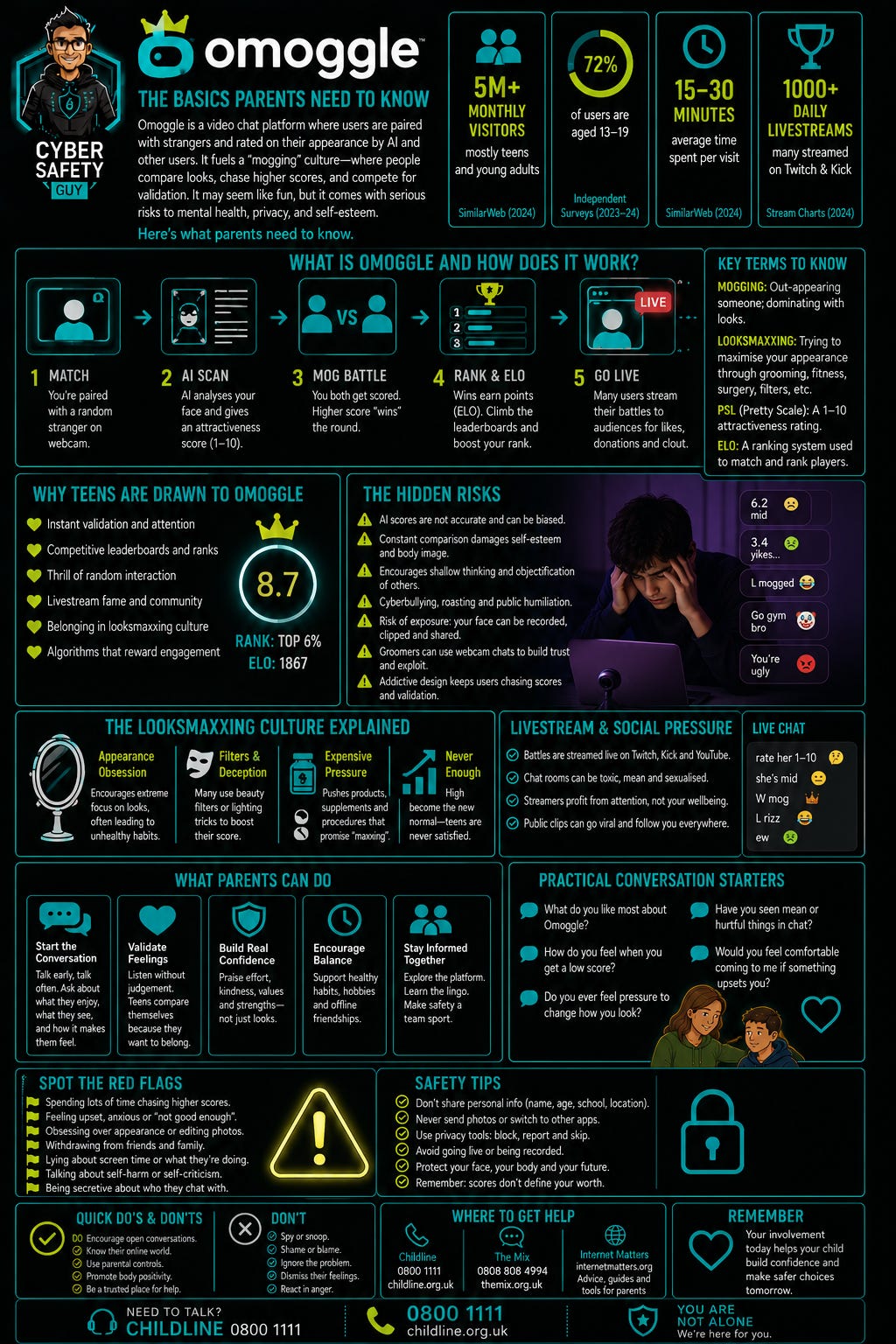
If your child mentions Omoggle, or “mogging,” or “face battles,” try asking what they think of it. Not what they have done with it. What they think of it. You are not interrogating them. You are opening the door.
If you want to block access to the site, you can do that at the router level or through parental control software. I have free guides at guides.cybersafetyguy.com that walk you through the process on most major devices.
But blocking is a temporary measure. The conversation is a permanent one.
Talk to them about what it means to be judged by a number. Ask them whether they think an algorithm can tell you whether someone is worth knowing. Ask what they would think of a friend who had been given a “Molecule” score, and whether that would change how they felt about that person.
These are not difficult conversations. They are important ones. And the young people most at risk from platforms like Omoggle are the ones who have never been invited into that conversation at all.
For teachers and DSLs
If you are a teacher or Designated Safeguarding Lead reading this, here is what I would suggest.
Bring it to your next safeguarding briefing. If students are talking about it, and they are, staff need to know what it is.
If you see students referencing looksmaxxing language, mogging terminology, or appearance-based ranking systems, that is worth a gentle conversation, not a disciplinary one.
If a student discloses distress related to how they have been rated or treated on a platform like this, treat it with the same seriousness you would any other online harm referral. Appearance-based humiliation is harmful. Full stop.
If you are concerned that a child is in distress, refer to your safeguarding procedures in the usual way. And remind students that Childline is always there.

As always, thank you for your support. Please share this across your social media, and if you do have any comments, questions, or concerns, then feel free to reach out to me via the Social page, as I am always happy to spend some time helping to protect children online.
Remember that becoming a paid subscriber means supporting a charity very close to my heart and helping it do amazing things for people. Childline, I will donate 100% of paid subscriptions collected every six months, as I don’t do any of this for financial gain.

If you or a child you know needs support:
Childline: 0800 1111 | childline.org.uk
Available 24/7, 365 days a year. Free, confidential, and here for every child.
Dexerto, “What is Omoggle? The AI face-rating platform taking over Twitch,” May 2026. https://www.dexerto.com/twitch/what-is-omoggle-the-ai-face-rating-platform-taking-over-twitch-3360363/ Note: Independently reported. Treat as current at time of writing.
Kirra Pendergast, "Miss, Have You Heard of Omoggle?" Substack, May 2026. https://kirrapendergast.substack.com/p/miss-have-you-heard-of-omoggle Note: First-hand platform assessment by a safeguarding professional. Platform user counts are point-in-time observations.
Yahoo Entertainment, "What Is 'Omoggle'? The PSL Scale Mogging Game Going Viral Online Explained," May 2026. https://sg.news.yahoo.com/omoggle-psl-scale-mogging-game-171455100.html Note: Twitch policy change confirmed across multiple outlets as of 5 May 2026.
Cyber Safety Project, “AI Face Rating Apps and Mog Battles: What Parents and Teachers Need to Know about Omoggle,” May 2026. https://cybersafetyproject.com/omoggle-parents-and-teachers-need-to-know/ Note: Independent analysis by an Australian child safety organisation.
great recap on this. strange trend.