

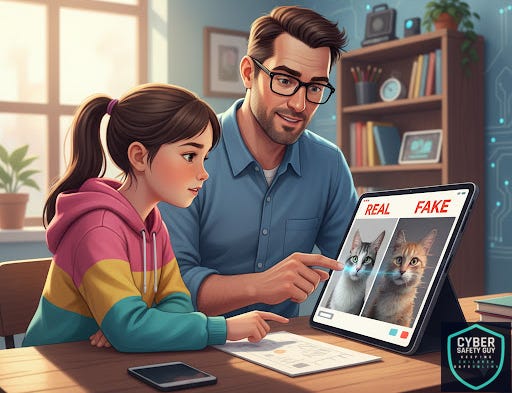
The internet has always been the Wild West, but with the constant evolution of Artificial Intelligence (AI), a new, more sophisticated layer of deception is emerging. It’s no longer just about “fake news”, but it is also now about extremely realistic fake videos, images, and audio, which you will often hear being referred to as deepfakes.
As parents and teachers, you are already grappling with screen time, cyberbullying, and exposure to inappropriate content. Now, you need to add a new skill to your children’s digital literacy arsenal, that is, the ability to discern what’s real from what has been manipulated by AI.
What Exactly Is a Deepfake?
Imagine a video of a famous person saying something they never said, or an image of an event that never happened, all created by a computer program that has learned to mimic real faces, voices, and actions. That’s a deepfake in a nutshell.
These aren’t just somebody messing with things using Photoshop. Deepfakes use very powerful AI algorithms to create new content, often making it difficult for the untrained eye to spot the fakes and sometimes even the trained eye. They can be created for harmless fun, but more and more we are seeing them being used for misinformation, scams, cyberbullying, and even more malicious purposes.
Why This Matters Now for Our Children?
As I have said previously, children are naturally curious and often will trust what they see and hear online.
During their escapades online, they might encounter deepfakes designed to:
Spread misinformation: Falsely depicting events or statements.
Target individuals: Creating fake, embarrassing videos or images for cyberbullying.
Promote scams: Using realistic counterfeit videos of trusted people to endorse fraudulent schemes.
Create confusion and distrust: Making it harder for them to distinguish reliable information from figments of the imagination.
We can’t shield them from encountering deepfakes, but we can equip them with the critical thinking skills to question what they see.
⚡Please don’t forget to react & restack if you appreciate my work. More engagement means more people might see it. ⚡
The New Digital Literacy: Practical Steps for Parents and Educators
This isn’t about becoming AI experts yourselves, but it is about creating healthy scepticism and observational skills in your children.
1. The “Pause and Question” Rule:
Teach your child to pause before reacting emotionally or sharing content. If something looks too shocking, too good to be true, or incredibly out of character for someone, it’s always worth a second look.
2. Look for the “Tells”
Whilst deepfakes are continually getting better, they will often still have subtle flaws. Your children should be on the lookout for things such as:
Unnatural Blinking or Eye Movement: Do the eyes look odd, or do they blink too little or too much?
Inconsistent Lighting or Shadows: Does the lighting on a person’s face match the background? Are shadows casting correctly?
Awkward Facial Expressions or Lip Sync: Does the mouth movement perfectly match the words being spoken? Are expressions stiff or unnatural?
Odd Skin Texture or Hair: Is the skin too smooth, too wrinkly, or are there blurry edges around the hair?
Inconsistent Audio Quality: Does the voice sound robotic, or does the audio cut out awkwardly?
3. Always Cross-Reference and Verify:
This is one of the most crucial facets of effective digital literacy. Teach your children to:
Check Trusted Sources: Is this story being reported by multiple reputable news organisations?
Reverse Image Search: Tools like Google Reverse Image Search or TinEye can help identify the origin of an image and if it has been used in other contexts.
Consider the Source: Is the content coming from a known, reliable account or an anonymous, new, or suspicious profile?
4. Discuss the Intent Behind Deepfakes:
Help your child understand why someone might create a deepfake. Is it to trick people? To make someone look bad? To spread a false idea? Understanding the malicious intent can help them be more aware and vigilant of them.
5. Practice Makes Perfect:
Look at examples together using articles or videos that showcase known deepfakes and then discuss them. Make it a game to spot the flaws.
The Role of Family Rules and the Digital Footprint
You should also discuss the ethics of creating their own deepfakes, even if they intend it as a joke. Creating deepfakes of friends or family can have serious consequences and contribute to a culture of misinformation. Emphasise that their digital actions have real-world impacts.
The age of AI manipulation is here to stay, but with guidance and education, I really believe that we can empower children to be savvy digital citizens, capable of navigating this complex landscape with confidence and, importantly, critical judgment.
As always, thank you for your support. Please share this across your social media, and if you do have any comments, questions, or concerns, then feel free to reach out to me here or on BlueSky, as I am always happy to spend some time helping to protect children online.
Remember that becoming a paid subscriber means that you will be supporting two charities that are very close to my heart and doing amazing things for people. The Not Forgotten Association and Childline, as I will split all subscriptions 50/50 and donate to each charity every six months, as I don’t do any of this for financial gain.

Love this perspective! It’s a huge challenge, isn't it? As someone passionate about AI, it reminds me of those incredible AI-generated images where you sometimes genuinely have to pause and wonder about their origin. But I agree, teaching kids early how to spot these things is absolutly essential.
You have to check out https://stealingurfeelin.gs/
It demonstrates how websites and apps use your camera to collect your emotions and sell them to vendors.
It helps people know how dangerous those cameras are.