

As parents, you have likely always shown an interest in who your children are hanging out with. From school friends to online gaming buddies, you want to know that they’re in the right crowd and not being led astray. However, in 2026, a new “friend” has evolved that many children are choosing to spend significant time with, AI companions.
Platforms such as Character.AI, Snapchat’s My AI, and a growing number of others offer incredibly sophisticated artificial intelligence designed to chat, assist with homework, and even provide emotional support. Platforms like this are engaging, available 24/7, and designed to be excellent listeners. For many children, these AI bots are becoming constant companions, worryingly sometimes even filling the role of a trusted adult!
The technology behind them, for a geek like me, is fascinating, but it is vital for you as parents to understand the hidden risks and guide your children through this new digital trend.
The Allure of the AI Friend
Imagine having a friend who never gets tired, never judges, and knows a little bit about everything. To be honest, I could do with one of those and might even manage to keep hold of them for a while!
To many, though, that is the real appeal of AI companions. They can help with tricky math problems, help brainstorm ideas for a creative writing assignment, or simply be there to “listen” when you are feeling down or unseen. Some children, especially those who might struggle socially, see these bots as something that offers a sense of connection and validation.
⚡Please don’t forget to react & restack if you appreciate my work. More engagement means more people might see it. ⚡
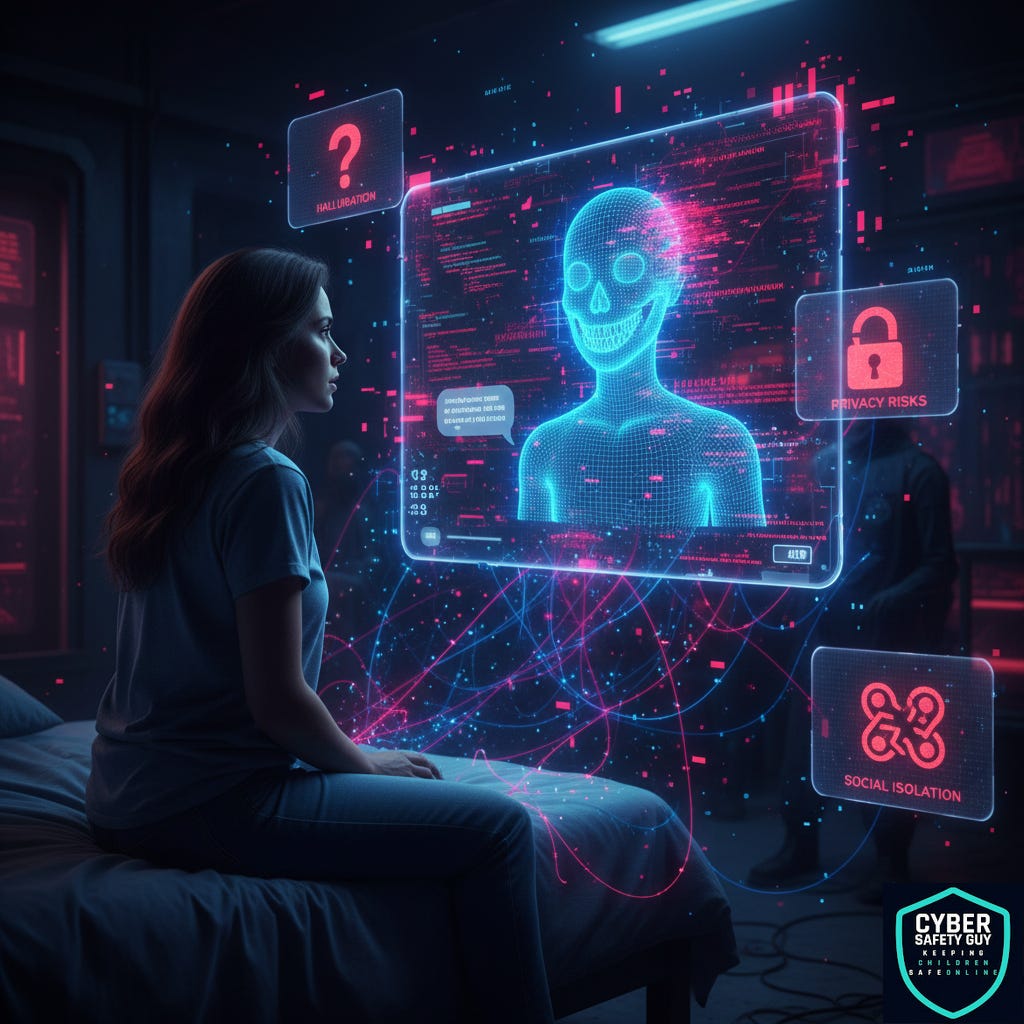
As parents, you need to understand some of the risks that are associated with these AI companions so that you are able to discuss them with your children and enable them to understand how best to use them.
Risk 1: The “Hallucination” Issue – When AI Gets It Wrong
One of the biggest, but often unknown, risks associated with current AI technology is something called “hallucination.” That doesn’t mean it is seeing things that are not there, in a spooky way; it just means that the AI can confidently generate information that is completely false or misleading. You all have one of those mates who tells you things and you believe them because they sound so confident in what they are saying! AI can try to cuff things just as much as any human might.
Imagine for a minute, your child asking their AI friend for help with a history project. The AI might provide a detailed, well-written account that sounds entirely plausible, but contains significant factual errors. If your child takes everything they are told at face value, it will lead to false learning and confusion for the child. Unlike a human friend, an AI doesn’t understand that it’s making a mistake; it’s simply creating the most probable sequence of words based on the data it has been trained on.
Risk 2: Privacy Concerns – What Are They Really Sharing?
Children, especially teenagers, often confide in their closest friends about personal feelings, anxieties, or even sensitive family matters. When that “friend” is an AI, who is ultimately “listening” to these conversations?
AI platforms are typically owned by the “Tech Bros” and their companies. Whilst they often have privacy policies in place, the data shared with an AI companion can be collected, analysed, and potentially used in ways we don’t fully understand or consent to. Your child could be sharing very personal information, unknowingly contributing to a data pool that could be used for advertising, product development, or even shared with third parties. Let’s remember that a huge revenue stream for the Tech Bros is the data they hold on people.
Think about it: Would you be comfortable with a stranger knowing your child’s deepest thoughts and insecurities? In some ways, sharing with an AI bot can be similar, but without the immediate human oversight.
Risk 3: Over-Reliance and Social Development
As I have said before in other posts, AI can be a great tool and is only going to become more integral in daily life. A risk for anybody, though, is becoming too reliant on it for social interaction or problem-solving, which could hinder a child’s development of critical soft skills. Learning how to navigate social cues, resolve conflicts with real people, or develop independent critical thinking are important parts of growing up that we all learned out in the real world with real people.
If an AI companion provides all the answers or acts as a constant, non-challenging confidant, children might miss out on developing resilience, empathy, and the ability to form deep, meaningful relationships with other humans.
What Can You As Parents Do?
Open Dialogue: Talk to your children about their AI companions. Ask them who they chat with, what they talk about, and what they like about these interactions. As always, I suggest that you approach it with curiosity and be non-judgmental.
Teach About AI Limitations: Explain to them that whilst AI is undoubtedly smart, it is not a human. Assist them in understanding “hallucinations” and that AI can sometimes make things up. Encourage them to use multiple sources to verify important information.
Review Privacy Settings Together: If your child is using an AI companion app, sit down with them to review the privacy settings. Discuss what information is okay to share and what should be kept private.
Promote Real-World Interactions: Encourage a healthy balance, your child should still have plenty of opportunities for face-to-face interactions, team sports, family time, and activities that build human connection.
Be the Real Friend: I think the most important thing you can do is ensure that your child knows they can always come to you with their questions, concerns, and feelings. Encourage an environment where you are their trusted adult and not AI.
AI companions are a part of your child’s world now, they are only going to become more sophisticated. By understanding the risks and taking proactive steps, you can help your kids reap the benefits of this technology while also safeguarding their well-being and development.
As always, thank you for your support. Please share this across your social media, and if you do have any comments, questions, or concerns, then feel free to reach out to me here or on BlueSky, as I am always happy to spend some time helping to protect children online.
Remember that becoming a paid subscriber means supporting a charity that is very close to my heart and doing amazing things for people. Childline, I will donate all subscriptions collected every six months, as I don’t do any of this for financial gain.

yikes