
Louis Theroux Went Inside the Manosphere: So Did Your Son

You watched Adolescence, didn’t you? A 13-year-old boy. A girl from his school. A phone full of manosphere content that told him she deserved it. I watched it in two sittings, and it took me three days to shake it off. And very little shakes me anymore (see that blog post below).
But here is the thing about Adolescence that has been gnawing at me since. It showed us what happens. It showed us Jamie Miller, the algorithm, the incel pipeline, the red pill, the knife. What it could not quite show us, because it is drama and not a documentary, is the who. Who are the men actually building this content? Who is running the machine that fed Jamie those ideas? What does the business model look like, and what exactly are they selling?

Louis Theroux just answered that question. Inside the Manosphere landed on Netflix on 11th March 2026, and I sat down and watched it with Colleen. I want to tell you what I think, not as a film critic, not as a TV reviewer, but as someone who spent eight years looking at what the internet does to children at its very worst. As your Digital Yoda (self-approved title), I have spent years explaining how the dark corners of the internet operate. This documentary pulled the curtain back on one of the darkest corners of all.
So What Actually Is the Manosphere?
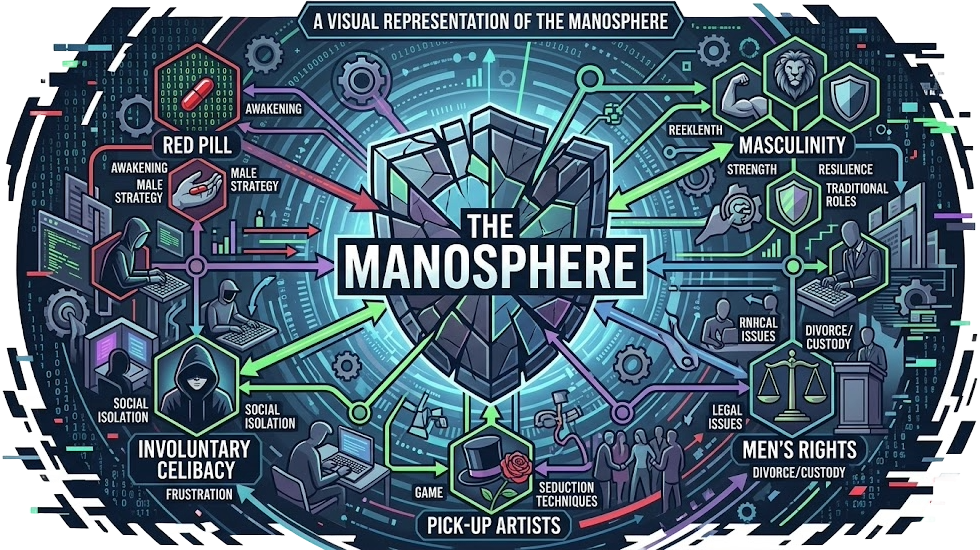
If you have heard the word and are not entirely sure what it means, you are not alone, and that is not a failing. The manosphere is not a single website you can block. It is a network of social media channels, podcasts, YouTube accounts, TikTok profiles, and Discord servers built around a very particular idea of what it means to be a man. At its mild end, you get fitness content, motivation, and financial advice. Nothing wrong with any of that on its own.
But the algorithm does not keep things mild for long.
At the extreme end, the manosphere tells boys that women are inferior, that feminism is an attack on men, that emotional vulnerability is weakness, and that respect from a woman has to be extracted rather than earned. It tells boys they are worthless unless they are wealthy, dominant, and physically imposing. And it makes an enormous amount of money doing it.
That is what Theroux went in to explore, and he did not pull his punches.
What Theroux Got Right
I have real respect for what Louis Theroux does, because he does something genuinely difficult. He sits with people he fundamentally disagrees with, listens, asks questions, and lets the subjects reveal themselves. It is a technique that requires patience, and sometimes it is infuriating to watch because you want him to challenge harder. Some critics have said the documentary is too soft, that it gives these men too much oxygen. I understand that criticism. I am not sure I agree with it.
What Theroux’s approach does, very effectively, is expose the gap between the image and the person. Harrison Sullivan, known online as HS Tikky Tokky, presents as a wealthy, dominant alpha male surrounded by security and women. In front of the camera, with Theroux quietly asking questions, you see something else entirely. Someone insecure, performing, craving attention that his brand demands. Someone who has built a persona so elaborate it has become a cage.
That, to me, is more instructive than any amount of confrontational interviewing, because it shows boys watching this documentary something the influencer never intended to show them: what the product actually looks like behind the packaging.
Theroux, as a parent of three boys himself, says it plainly: these influencers spend more hours a day with your son than you do. That landed like a stone in still water when I heard it, because I have been saying something very similar for years.
Why Andrew Tate's Refusal to Appear Tells You Everything
Andrew Tate is not in this documentary. That is worth sitting with for a moment.
He was asked. He agreed, conditionally. His condition? Pay me.
Theroux said no. And so Tate walked.
I want you to think about what that tells you. Here is a man who presents himself as a champion of young men, a crusader against a broken system, a truth-teller who says what the establishment does not want you to hear. And when the opportunity came to sit down with one of the most respected documentary makers in the world, and make the case for his movement, and be given a genuine platform? He wanted a fee.
He is not a movement. He is a product. And your son is the customer.
That is the business model of the manosphere in a single anecdote. The content is designed to make boys feel seen, understood, and angry. The anger is monetised. The boys pay for courses, memberships, and merchandise. The influencers get wealthy. The boys get a set of beliefs that will make it harder for them to form healthy relationships for years.
I am not being dramatic. I have seen where this ends. Not just in case files, but in the families who contact me. In the parents who tell me their teenage son has started saying things at the dinner table that they do not recognise.
Your Son’s Algorithm Is Already Working on Him
Here is the “what if” I need you to consider, because this is the one that matters most.
Your son may not have searched for Andrew Tate. He may not have looked for incel content. He may not have typed “how to be an alpha male” into a search bar. It does not matter.
Research has found that fake social media accounts set up to mimic teenage boys were fed manosphere content by the algorithm without actively searching for it at all. Simply having a profile that reflected the interests of an average teenage boy was enough for the platforms to start suggesting it. You do not have to go looking for this content. It comes looking for you.
Your son is on TikTok. He is on YouTube. He is on Instagram. And somewhere in his recommendations, almost certainly, there is content from the edges of this world. Not necessarily the extreme end. Maybe just fitness content with a particular flavour. A podcast that sounds motivational but uses language you would wince at. A comment section that is... different.
The algorithm is not your ally here. There is no money in keeping boys safe. There is enormous money in keeping them engaged, and nothing engages a teenage boy more reliably than content that tells him the world has wronged him.
What You Can Actually Do Tonight?
This is not about snatching their phones or installing monitoring software, though I understand the instinct. This is about conversation, because the research is detailed on one thing: if your son feels he cannot come to you without being lectured, he will not come to you at all. The manosphere will fill that gap with something far worse than a difficult conversation, which is why I always say that open, honest, non-judgmental communication is the key.
Here is what I would do:
Watch the documentary yourself first. You need to understand the landscape before you start the conversation. Inside the Manosphere is on Netflix now. It is about 90 minutes. You will come out of it understanding what your son is being fed far better than you did going in.
Then watch it with your son, if he is old enough. The documentary does something very useful: it shows the men behind the content as they actually are, insecure, performing and monetising the loneliness and confusion of boys. Watching it together gives you a shared reference point for a conversation that does not feel like an interrogation.
If he has already found this content, do not panic and do not lecture. Ask questions first. “What do you think of that?” works better than “you should not be watching that.” The moment a parent tells a teenage boy that the content he likes is wrong, the “they don’t want you to know this” framing of the manosphere kicks in, and you have lost him.
Ask him what he is watching. Not accusatorially. Genuinely. Sit with him. See what his YouTube recommendations look like. See what TikTok is serving him. If you see content you are not sure about, ask about it. Be curious, not panicked.
Tell him it is okay to feel like life is unfair. Because sometimes it is. The manosphere recruits from genuine feelings of inadequacy, loneliness, and rejection. Those feelings are real and valid. The solution the manosphere offers is toxic, but the feeling underneath it is not. Meeting that feeling with empathy rather than dismissal is the most powerful thing you can do.
Stay in the conversation. This is not a one-off chat. This is an ongoing relationship. Keep the door open. Keep asking. Keep listening.
⚡Please don’t forget to react & restack if you appreciate my work. More engagement means more people might see it. ⚡
Frequently Asked Questions
My son has already been watching this content. Is it too late?
No. It is not too late. The key is the conversation, not the confiscation. Boys leave the manosphere when they find something better: better community, better ideas, better relationships. You can be part of what offers that alternative. Start with curiosity, not confrontation.
Should I block these influencers on his devices?
Probably not as your first move. Research suggests that prohibition without conversation can reinforce the “forbidden knowledge” appeal that is central to the manosphere’s brand. If you have had the conversation and built trust, a decision to limit certain content can become collaborative rather than imposed.
What is the difference between Adolescence and this documentary?
Adolescence is a work of fiction, inspired by real cases. Inside the Manosphere is a documentary. One shows you the consequence, the other shows you the cause. Together, they are probably the most useful pair of things currently on Netflix for parents trying to understand what boys are being fed online.
Is the manosphere a problem for girls too?
Yes, although differently. Girls are more often targets of the ideology than consumers of it, though not exclusively. The wider impact on teenage relationships, on how boys treat girls at school and online, is significant and worth a separate conversation.
Where can I learn more and get support?
Childline (childline.org.uk) is an excellent resource for children and young people. The Internet Watch Foundation (iwf.org.uk) does vital work on online safety. And I am always here, so reach out through the blog or find me on BlueSky.
Keep fighting the good fight, stay up-to-date, and keep the conversations alive and kicking. I don’t want your son to become just another statistic, nor should you. You are not alone in this, and there is a whole community of parents navigating the same landscape with a geek like me pointing the way.

As always, thank you for your support. Please share this across your social media, and if you do have any comments, questions, or concerns, then feel free to reach out to me here or on BlueSky, as I am always happy to spend some time helping to protect children online.
Remember that becoming a paid subscriber means supporting a charity that is very close to my heart and doing amazing things for people. Childline, I will donate all subscriptions collected every six months, as I don’t do any of this for financial gain.
