

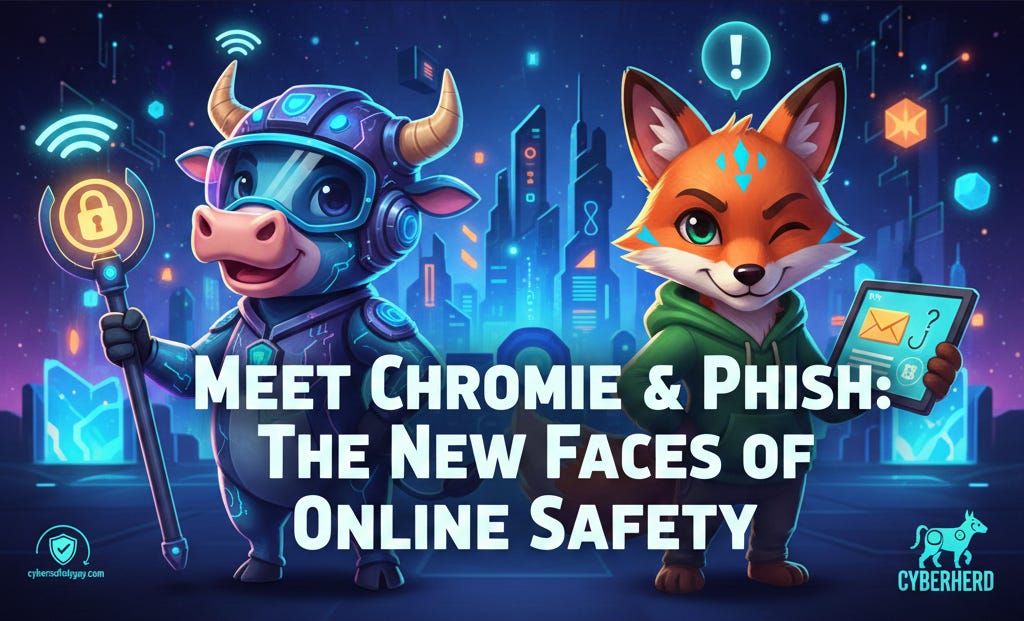
Ok, I am the first person to admit the issue with trying to explain cyber safety to a child! Trying to teach a 9-year-old about phishing simulations or the complexity requirements for passwords is going to be about as effective as explaining tax law to my wee man Leffe. I can almost see their eyes glaze over as I type, they nod politely, and then they go right back to clicking the big red shiny “FREE ROBUX” button.
As parents and teachers, you are already aware that the stakes are high, but the lecture format and even good communication alone may not stick with many children. That’s why I was interested when, on my Linkedin I recently stumbled upon a new platform that speaks the only language some children actually want to listen to: Gaming.
It’s called CyberHerd, and if you have children or students aged 7-14, then I suggest you bookmark this one.
⚡Please don’t forget to react & restack if you appreciate my work. More engagement means more people might see it. ⚡
What is CyberHerd?
CyberHerd is a browser-based platform that turns sometimes challenging cyber safety lessons into playable games. Instead of reading a checklist about online safety, children launch themselves into a sci-fi universe where they must help a cast of animal characters defeat “Bots” that represent real-world digital threats.
The feel is very much “Saturday Morning Cartoon meets Cyber Security.” It’s colourful, it’s fast, and most importantly, it’s fun!.
The Games: Learning by Doing
Currently, the platform features a couple of core adventures that tackle two of the big hitters of online safety:
1. Password Power (with Chromie the Cyber Cow) * The Mission: Kids pilot a “Cyber-Time Shuttle” and have to defend a star-vault from “CrackBot’s brute-force drones.”
The Lesson: To build their defences, players have to craft strong passwords. It visualises the concept that a weak password lets the drones right in, whilst a strong, complex one creates an impenetrable barrier. It’s a brilliant way to show why “123456” is a bad idea without just saying “don’t do it.”
2. Spot-la-Fish (with Phish the Fox) * The Mission: “PhishBot” is flooding the Neon Reef with fake mail. Players have to save the reef by identifying which emails are scams.
The Lesson: This is straight-up anti-phishing training. children learn to spot red flags, suspicious senders, urgent demands, and weird links—in a safe environment where the only consequence of clicking wrong is a lower score, not a stolen identity.
What’s Coming Next?
One thing I like about the CyberHerd platform is its roadmap. They are clearly working to build a full curriculum. I noticed teasers for upcoming modules that address some important topics:
Wispa’s Info Quest: Tackling misinformation and fake news.
Shade’s Shadow Streams: Teaching kids about their digital footprint and privacy.
Bully-Buster: A module specifically for handling cyberbullying.
The Verdict for Parents and Teachers
Pros:
High Engagement: It meets kids where they are. The gameplay mechanics (collecting items, defeating bots) are genuinely interactive.
Zero Setup: It runs in the browser. No complex installations for the school IT guy to block or parents to tackle.
Age Appropriate: Perfect for the 7–14 age range, when children are just starting to become more independent online.
Cons:
Early Days: It’s a newer platform, so the game library is still growing. You might finish the current adventures quickly, but the “Coming Soon” list looks promising.
If you are looking for a way to start the conversation about online safety without getting the dramatic “eye roll,” CyberHerd is a great intro. It positions children as “Guardians” of their own digital space rather than potential victims, and that empowerment makes all the difference in my honest opinion.
Check it out at cyberherd.online/learn and let Chromie and Phish do the heavy lifting for you!
Great Work by Joe Wells, who has put everything into this project to help protect your children in a dangerous online world. I, for one, appreciate having another great resource to do so.
As always, thank you for your support. Please share this across your social media, and if you do have any comments, questions, or concerns, then feel free to reach out to me here or on BlueSky, as I am always happy to spend some time helping to protect children online.
Remember that becoming a paid subscriber means supporting a charity that is very close to my heart and doing amazing things for people. Childline, I will donate all subscriptions collected every six months, as I don’t do any of this for financial gain.

Here is a blog post written for www.cybersafetyguy.com, tailored to your persona and audience.
First I've herd of it! Pun!
Keep up the great work!