
Not All Predator Catchers Are Created Equal

If you're a parent and you've ever watched one of those viral videos of someone confronting an alleged paedophile in a car park, live on Facebook, while hundreds of thousands of people watch in real time, I understand the appeal, I really do.
The anger you feel when you think about what could happen to your child online is raw and visceral; it sits in your gut. When you see someone apparently doing something about it, putting themselves out there, catching these people, it feels like justice. It feels like someone is finally fighting back.
But here is the uncomfortable truth: a lot of what you are seeing is not justice. It is content; the difference between the two is the difference between a predator going to prison and a predator walking free.
I want to talk about that difference today. I want to introduce you to a group that, in my opinion, is doing it the right way.
The Rise of the Predator Hunters
Over the last decade, the UK has seen an explosion of self-styled paedophile hunting groups. Names like Stinson Hunter, Dark Justice, Online Predator Investigation Team, and Paedophile Hunters London have built huge followings on social media. Their method is broadly the same, pose as a child online, wait for an adult to make contact, then arrange a meeting and confront them on camera. The footage goes live. The comments pile up. The shares go through the roof.
And in fairness, some of these groups have contributed to real convictions. In 2018, BBC analysis found that of the 403 people prosecuted for attempting to meet a child following sexual grooming, 252 of those cases involved evidence gathered by paedophile hunting groups. That is over 60%. On the face of it, that sounds like it is working.
But the picture is far more complicated than the numbers suggest.
When It Goes Wrong
The National Police Chiefs' Council has repeatedly warned that some of these groups are committing offences themselves, including extortion, blackmail, and violence against their targets. That is not my opinion, but that is the assessment of senior police officers who deal with this every day.
And the harm goes further than you might think.
In 2000, a paediatrician named Dr Yvette Cloete was hounded from her home by a mob who confused her job title with the word paedophile. In the same year, a man named Iain Armstrong was attacked because he wore a similar neck brace to a convicted sex offender. In 2013, Bijan Ebrahimi, a disabled Iranian refugee living in Bristol, was beaten, dragged from his home, and set on fire by a neighbour who wrongly believed he was a paedophile. Two police officers were later imprisoned for ignoring his desperate calls for help. Bijan died because of that accusation.
These are not edge cases. A New York Times analysis identified over 170 violent vigilante attacks by paedophile hunters since 2023 alone. Cars were firebombed, houses were graffitied, people were chased through shops, and were beaten in the street.
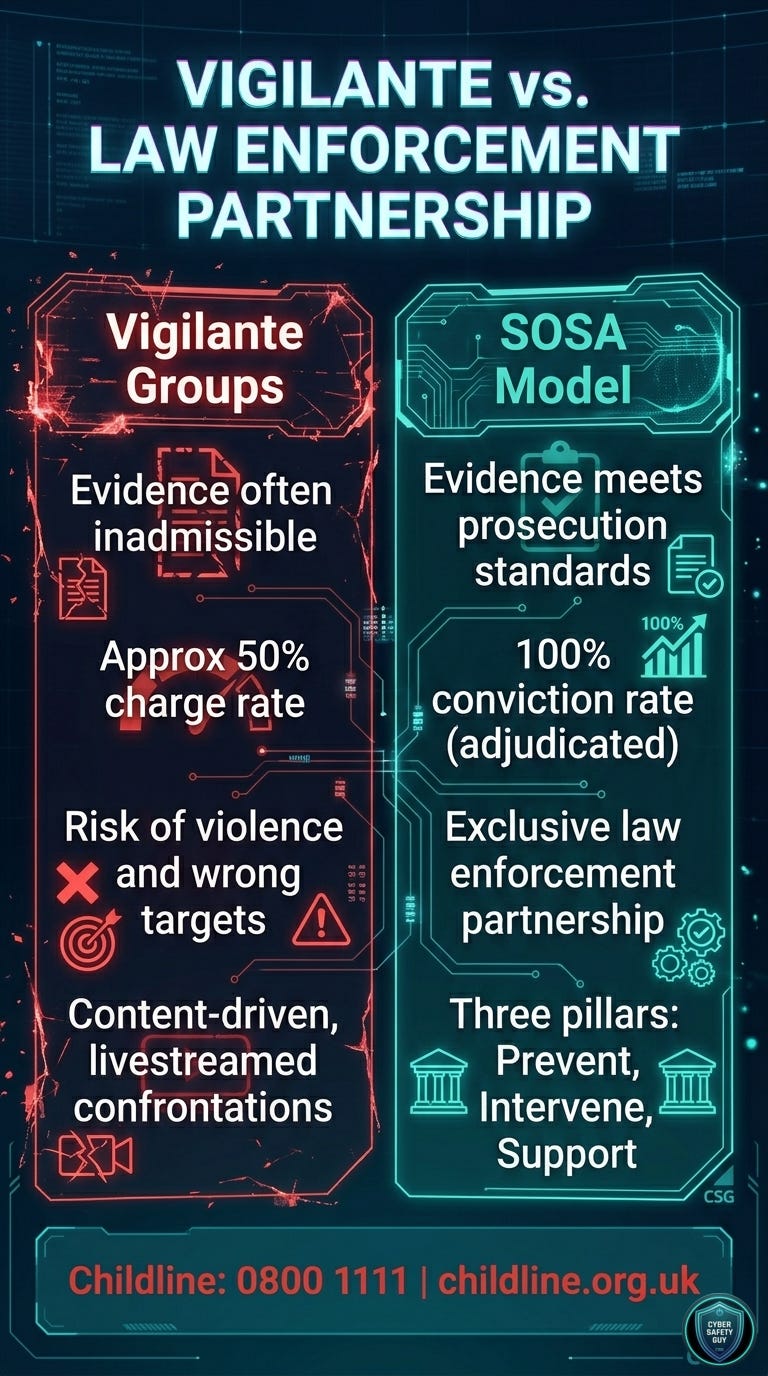
But even when the right person is targeted, the cases often collapse. Evidence gathered outside of proper legal frameworks is frequently inadmissible in court. The very act of livestreaming a confrontation can prejudice a jury. In some groups, only around half of their targets are ever charged with a crime, let alone convicted.
So the question becomes, is this really about protecting children? Or is it about views?
Enter SOSA
In 2019, an American writer and child advocate named Roo Powell spent a week posing as an 11-year-old girl on the internet. She wrote about it. The piece went viral, viewed over 7 million times and covered by outlets around the world. It could have ended there, as another shocking article people share and forget about. But Roo did something different. She built an organisation.
SOSA stands for Safe from Online Sex Abuse. It is a US-based nonprofit, and it operates in a way that is fundamentally different from the vigilante groups you see on your social media feeds.
The single most important thing to understand about SOSA is this: they never, ever run an operation without law enforcement. Every undercover operation is conducted in partnership with ICAC (Internet Crimes Against Children) task forces, with parameters agreed by the district attorney's office. Every piece of evidence is gathered to legal prosecution standards. Every step of the process is designed to lead to one thing: a conviction that sticks.
We are never running an op unless we are partnered with law enforcement. We are never doing this on our own. I think what separates us from vigilante groups is that distinction.
That quote is from Roo Powell herself. And the results speak louder than any viral video. SOSA currently holds a 100% conviction rate on all adjudicated cases. Not 50%. Not 60%. One hundred per cent. Because the evidence is gathered properly, within the law, in collaboration with the people whose job it is to prosecute.
Three Pillars, Not Just One
What really sets SOSA apart, and what really caught my attention, is that catching predators is only one part of what they do. Their model has three pillars: prevention, intervention, and support.
Prevention is about education. SOSA works with families, schools, and communities to spread awareness about the tactics predators use, the red flags to watch for, and the conversations parents need to be having with their children. If you are reading this newsletter, you already understand how important that is. Education is the frontline and always has been.
Intervention is the undercover work. The decoy operations are in partnership with law enforcement. The careful, methodical process of identifying perpetrators, compiling evidence, and handing it to detectives and prosecutors. This is the part you might have seen on Undercover Underage, the Discovery+ docuseries that followed Roo and her team in real time.
Support is about what happens after the abuse. SOSA runs a Survivor Therapy Programme, connecting survivors of online child sex abuse with fully licensed therapists and covering the cost of treatment. They also support the families of perpetrators, recognising that the collateral damage from these cases extends further than most people think about.
That three-pillar approach is what makes this a serious, sustainable model for child protection, not just a spectacle designed for social media engagement.
⚡Please don’t forget to react & restack if you appreciate my work. More engagement means more people might see it. ⚡

Why This Matters for Us
I started Cyber Safety Guy back in 2013 because I believed, and still believe, that most online harm to children is preventable through education and communication. That belief came from my years working in digital forensics with the RAF Police, where I saw firsthand what happens when prevention fails. It is not theoretical for me. I have seen the evidence. I have been damaged by the evidence.
And that is exactly why I find SOSA's approach so important. They understand that catching one predator at a time is necessary but not sufficient. The real work is in equipping parents, teachers, and children with the knowledge to recognise danger before it reaches that point.
Here in the UK, the Online Safety Act and Ofcom's new enforcement powers are steps in the right direction. But legislation moves slowly, and platforms continue to resist meaningful change. In the meantime, organisations like SOSA show us what structured, law-enforcement-aligned child protection looks like when it is done properly.
The model is not about replacing the police. It is about working with them. It is not about going viral. It is about going to court.
What You Can Do
If this post has made you think twice about sharing the next predator hunter video, good. Here is what you can do instead:
Talk to your children. Have age-appropriate conversations about online safety. Not once. Regularly. Make it normal, not scary.
Learn the platforms your children use. You do not need to be a tech expert. You just need to know enough to ask the right questions.
Report concerns properly. In the UK, report to CEOP (the Child Exploitation and Online Protection command) at ceop.police.uk. Do not rely on social media vigilantes to do this for you.
Support organisations doing it right. SOSA is one of them. You can learn more at sosatogether.org.
Share content that educates, not just content that shocks. The viral confrontation video might feel satisfying in the moment, but a parent reading an article about how to recognise grooming signs will do more long-term good.
Final Thought
I get the anger. Trust me, I get it more than most. But anger without structure does not protect children. It just creates noise. And noise is what predators hide behind.
Organisations like SOSA prove that there is a better way. One that respects the law, secures convictions, educates communities, and supports the people who have been harmed.
That is the standard we should all be demanding.
If you or a young person you know is struggling, Childline is free, confidential, and available 24 /7.
Child line: 0800 1111 | childline.org.uk

As always, thank you for your support. Please share this across your social media, and if you do have any comments, questions, or concerns, then feel free to reach out to me, as I am always happy to spend some time helping to protect children online.
Remember that becoming a paid subscriber means supporting a charity that is very close to my heart and doing amazing things for people. Childline, I will donate all subscriptions collected every six months, as I don’t do any of this for financial gain.

If you or a child you know needs support:
Childline: 116 000 | childline.org.uk
Available 24/7, 365 days a year. Free, confidential, and here for every child.