
*Breaking* UK Social Media Ban
What It Means for Your Child


UK Social Media Ban: What the Under-16 Law Actually Covers
Today is a significant moment for child online safety in the UK.
Prime Minister Keir Starmer stood at Downing Street this morning and announced that children under 16 will be banned from social media.
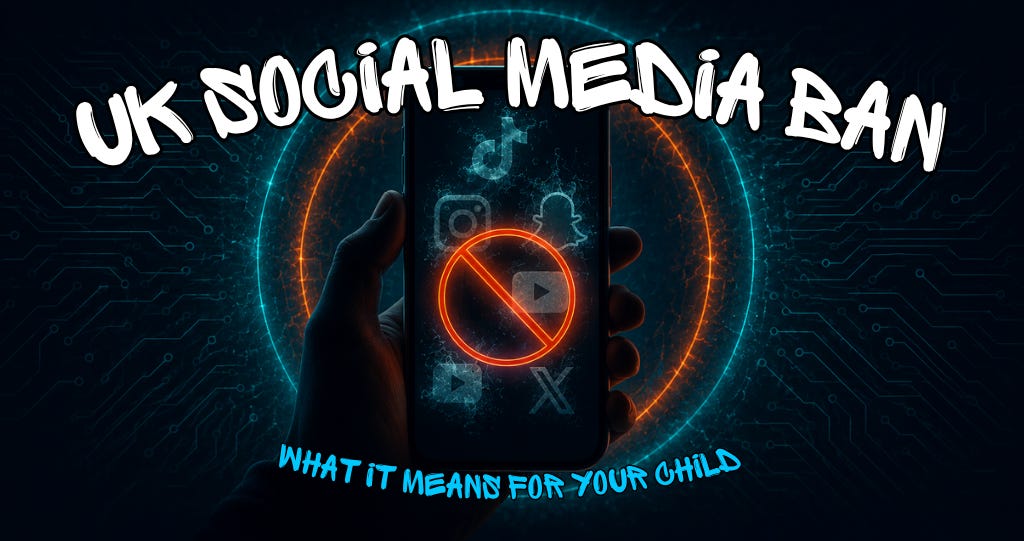
TikTok | Instagram | Snapchat | YouTube | Facebook | X
All named, all in scope. The government says legislation will be before Parliament before Christmas, with the ban coming into force around spring 2027.1
I have been campaigning alongside parents, teachers and safeguarding professionals on this issue for years. So yes, I welcome this, but I want to be open with you about what this is, what it is not, and what still needs to happen.
Because a headline is not the same as a solution.
What the UK Under-16 Social Media Ban Actually Covers
The platforms named in the announcement are Snapchat, TikTok, YouTube, Instagram, Facebook and X. Messaging services such as WhatsApp and Signal are not included.2
That distinction is important. Messaging apps carry their own risks, but the government has focused its first move on public social media platforms, where algorithmic content delivery does the most damage.
The legislation will also go “a bit further” than Australia’s comparable ban, which came into force in December 2025. The UK says it will introduce what it describes as “world-leading blocks on harmful functions such as livestreaming and stranger communication with children.”3
That second part is one most people have not picked up on yet. Gaming platforms and livestreaming sites are explicitly in scope. Strangers contacting children through those channels will also be restricted. If that gets implemented properly, it is genuinely significant.
The Part Nobody Is Talking About: Gaming and Livestreaming
I am aware of many cases where the initial contact between an offender and a child happened on a gaming platform, not a dark corner of the internet, not a specialist grooming site, but a mainstream game.
Voice chat in Fortnite. Private messages in Roblox. Discord links dropped into game lobbies.
The majority of grooming cases now begin on platforms that parents consider safe. Games, YouTube and livestreams. The announcement that these will be brought into scope alongside the social media platforms is the most important line in today’s news that very few people will recognise.
A Welcome First Step, But Enforcement Is the Real Test
Australia introduced this ban in December 2025. Children are still on these platforms.4 Age verification at scale is hard. The technology does not yet exist in a form that works reliably without creating significant privacy risks for adults.
The UK government has given tech companies a three-month ultimatum to implement device-level safety software. Failure to comply will result in legislative penalties. Starmer was direct, if platforms resist, he will fight back.
That language is encouraging, but I have seen this film before. The Online Safety Act received Royal Assent in October 2023. The Protection of Children Codes only came into force in July 2025. Nearly two years between law and enforcement. Eight years from initial proposal to legislation. In my world, words are cheap, action is the only thing that matters.
The platforms have the resources to delay, lobby and water things down. Starmer acknowledged this himself, describing a tendency toward “learned helplessness” when it comes to tech regulation. He is right and it will require sustained political will to resist it.
⚡Please don’t forget to react & restack if you appreciate my work. More engagement means more people might see it. ⚡
What This Means for Platforms: Finally Some Accountability
These platforms did not accidentally become harmful to children. They were built to maximise engagement. Infinite scroll, algorithmic amplification of emotionally charged content, notification systems designed to pull children back in and features that reward attention over wellbeing. None of that happened by accident, it happened by design.
Internal Meta research, leaked in 2021 and confirmed in court proceedings, showed the company knew Instagram was harming teenage girls and continued anyway.5 TikTok’s algorithm has been shown to serve self-harm and eating disorder content to newly registered teen accounts within minutes.
A ban puts pressure on platforms. It does not excuse them from what they have already done, or from the ongoing responsibility to make their products safer. Accountability and a ban are not alternatives. We need both!
What Parents and Teachers Should Do Right Now
For parents:
This ban will not come into force until spring 2027 at the earliest. Your child is on these platforms right now. Use the conversation that today’s news has opened up. Ask them what they use, what they enjoy and what they have seen that worried them. The ban will not replace that conversation, nothing should ever replace that
For teachers and DSLs:
Update your safeguarding knowledge to include gaming and livestreaming platforms. The announcement today puts those platforms in scope, but the risks exist now. Review your school’s online safety policy to ensure it reflects where children are actually spending their time, not just where we assume they are.
For everyone:
The free guides at guides.cybersafetyguy.com cover the platforms your children are most likely using, with plain-English parental controls for each one. Use them today, not in 2027.
The Bigger Picture
The UK joins Australia, Canada, Brazil and Indonesia in moving to restrict under-16s’ access to social media.6 This is a global shift. Governments around the world are arriving at the same conclusion, the platforms cannot be trusted to self-regulate when it comes to children.
Esther Ghey, whose daughter Brianna was murdered in 2023 by two teenagers who had accessed harmful content online, said today that this ban would “potentially save some lives.” She has campaigned with extraordinary dignity for years to get to this moment. Whatever questions remain about enforcement, this announcement is, in part, because of her.
This is a good first step, a meaningful one. But it is a first step. The test will be enforcement, and that is where the platforms will push back hardest.
Keep watching, keep asking questions and keep talking to your children.
As always, thank you for your support. Please share this across your social media, and if you do have any comments, questions, or concerns, then feel free to reach out to me via the Social page, as I am always happy to spend some time helping to protect children online.
Remember that becoming a paid subscriber means supporting a charity very close to my heart and helping it do amazing things for people. Childline, I will donate 100% of paid subscriptions collected every six months, as I don’t do any of this for financial gain.

If you or a child you know needs support:
Childline: 0800 1111 | childline.org.uk
Available 24/7, 365 days a year. Free, confidential, and here for every child.
HuffPost UK, “What You Need To Know About Keir Starmer’s Under-16 Social Media Ban,” 15 June 2026. https://www.huffingtonpost.co.uk. Reports legislation planned before Christmas, enforcement from spring 2027. Based on government press conference statements; final timeline subject to parliamentary process.
ABC News, “Britain will ban under-16s from using a range of social media apps,” 15 June 2026. https://abcnews.com. WhatsApp and Signal explicitly excluded from scope per official announcement.
TechRadar, “UK bans social media for under-16s, live,” 15 June 2026. https://www.techradar.com. Government described “world-leading” restrictions on livestreaming and stranger contact. Specific platform scope subject to final legislation.
Observation based on widely reported outcomes following Australia’s December 2025 ban. Age verification enforcement gaps are acknowledged by the Australian government. Automated outputs, not independently verified assessments.
Meta internal research findings widely reported from 2021 onwards and referenced in US Senate testimony and subsequent legal proceedings. The leaked documents are a matter of public record.
ABC News, 15 June 2026. Countries including Australia, Canada, Brazil and Indonesia referenced as part of a growing global movement to restrict under-16s' social media access.
There isn't a lot they can do if parents allow children to use their accounts and regarding guest accounts I would expect those to be tightened up when legislation comes into effect in 27.