

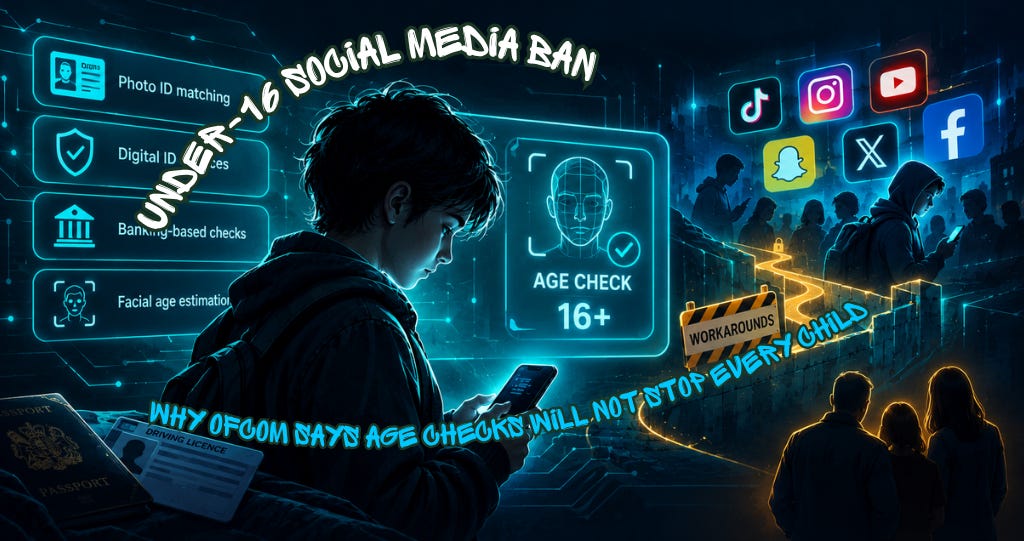

Why Ofcom says some children will still slip through the social media ban
Ofcom published its age assurance guidance on 29 October 2026, and buried inside the technical language was an admission every parent needs to know, some under-16s will get around these checks. The regulator called it “inevitable.”1 If you were hoping this ban would handle online safety for you, that single word should give you pause to think again.
The ban, announced in June 2026, targets Snapchat, TikTok, YouTube, Instagram, Facebook and X. Messaging apps like WhatsApp and Signal are not included. The government aims to lay regulations before Parliament by the end of 2026, with the ban coming into effect from spring 2027.2 Platforms, not parents, bear the enforcement responsibility. Ofcom it is said will hold them to account.
But here is what the headlines are not telling you, even the regulator does not believe technical controls alone can solve this.
The four age checks Ofcom recommends
Ofcom identified four methods it considers “currently capable of being highly effective” at verifying whether someone is 16 or over:
1. Photo ID matching (passport or driving licence checked against a selfie)
2. Digital ID services (third-party identity verification platforms)
3. Banking-based checks (age derived from bank account data)
4. Facial age estimation (AI-based analysis of facial features)
Each method has its place. Each method has its limits and each method will likely incur the wrath of the “Privacy Warriors”.
Why facial age estimation is not the silver bullet
Facial age estimation sounds futuristic and foolproof. It is neither. Ofcom’s own guidance acknowledges that this technology can be inaccurate by several years, meaning some users would need to complete a second check. For a 14-year-old who looks older, or a 17-year-old who looks younger, the margin of error creates real problems.
The following is a number that also becomes an issue, approximately 150,000 16 and 17-year-olds in the UK have neither a driving licence nor a passport. For them, proving their age becomes genuinely difficult. For determined younger teenagers without ID, the path to workarounds becomes easier to justify.
I know how technically adept this generation of children are
I have been saying for quite a while that children will find ways to bypass most technical controls. That is why communication is my first advice, always. Children will find ways around controls and share them amongst their peer groups across all platforms they use.
This is not pessimism. This is pattern recognition from eight years of digital forensics work where I saw, time and again, how technical solutions failed when they were treated as the whole answer.
Andy Burrows is not wrong to be sceptical
Andy Burrows from the Molly Rose Foundation has said he has “little confidence the ban could be delivered successfully.”3 I fully agree with him, and I believe it will only prevent a small percentage of motivated children from finding workarounds.
Age verification is only part of a much larger issue. Until social media platforms are forced to take full accountability for the safety of children who use them, a ban alone will not be successful. If platforms took child safety as seriously as they take fighting against regulation, there would be no need for a ban.

As my previous posts about ByteDance prove, creating a safer platform is both simple and effective when the will exists. The technology is not the barrier. The business model is.
Why platforms will do the bare minimum
A parent might read this news and think, “Great, the platforms will handle it now.” But if you have followed me for any period of time you will know that the platforms do not have the safety of your child at heart, and likely never will. They will always do the bare minimum to tick a box.
You need to be responsible for ensuring your children are aware of the risks, but also know that they can come to you when something does not feel right. I truly believe that the responsibility for protecting children online should belong to the platforms that entice children to use them. But for now, parents will need to bear the brunt of that responsibility.
The ban shifts legal accountability to the platforms. It does not shift parental responsibility anywhere.
⚡Please don’t forget to react & restack if you appreciate my work. More engagement means more people might see it. ⚡

What this means for designated safeguarding leads
If you work in a school, you will have students who are already on these platforms, students who will find workarounds after the ban takes effect, and students who will assume the rules do not apply to them (I think that last one was me at school 😉).
Your role does not change:
• Keep conversations going about online safety in age-appropriate ways across all year groups
• Brief parents on what the ban does and does not do, because many will assume it solves the problem
• Watch for signs that students are sharing workarounds, whether that is shared logins, VPN use, or older siblings’ accounts
• Update your safeguarding policies to reflect that platform access may become harder to verify, not easier
The ban is a regulatory tool. Your school’s culture of open communication about online risk remains the frontline.
What parents should actually do now
The ban does not kick in until spring 2027. Between now and then, and even after, here is what matters most:
Talk! Regular and non-judgmental chats that also enable children to develop critical thinking skills. If you shut them down or punish them, you have already lost. When they need you most, they will keep secrets from you. And predators thrive on secrecy.
The only parental control you can fully control is communication. Start it early and make sure it is often. It is not about having one big serious conversation. It is about lots of smaller chats over time so they become comfortable talking to you.
Technical controls fail. Conversations do not.
If people put all of their trust in technical solutions, they will be disappointed, because technical solutions can and often do fail. The age checks coming in 2027 will stop some children from accessing platforms they should not be on. They will not stop all of them and they will not protect any child from what they encounter once they are there.
The legislation is necessary. But it is not sufficient.
Your relationship with your child, your willingness to listen without judgement, your ongoing conversations about what they see and who they talk to online: that is the protection that scales. That is the protection that adapts. That is the protection no workaround can bypass.

As always, thank you for your support. Please share this across your social media, and if you do have any comments, questions, or concerns, then feel free to reach out to me via the Social page, as I am always happy to spend some time helping to protect children online.
Remember that becoming a paid subscriber means supporting a charity very close to my heart and helping it do amazing things for people. Childline, I will donate 100% of paid subscriptions collected every six months, as I don’t do any of this for financial gain. Or to make a one-off donation, go to my Just Giving page.

If you or a child you know needs support:
Childline: 0800 1111 | childline.org.uk
Available 24/7, 365 days a year. Free, confidential, and here for every child.
Ofcom, “Age Assurance Guidance for User-to-User Services,” published 29 October 2026. https://www.ofcom.org.uk.
UK Government announcement, 15 June 2026, confirmed via BBC News and Sky News reporting, 29 October 2026. Spring 2027 implementation date is the government’s stated aim; final timing subject to parliamentary process.
Andy Burrows, Molly Rose Foundation, quoted in Sky News, 29 October 2026.