

Recently, a colleague tagged me in a post on LinkedIn suggesting I deserved an honour for the work I do with Cyber Safety Guy.
An MBE, no less.
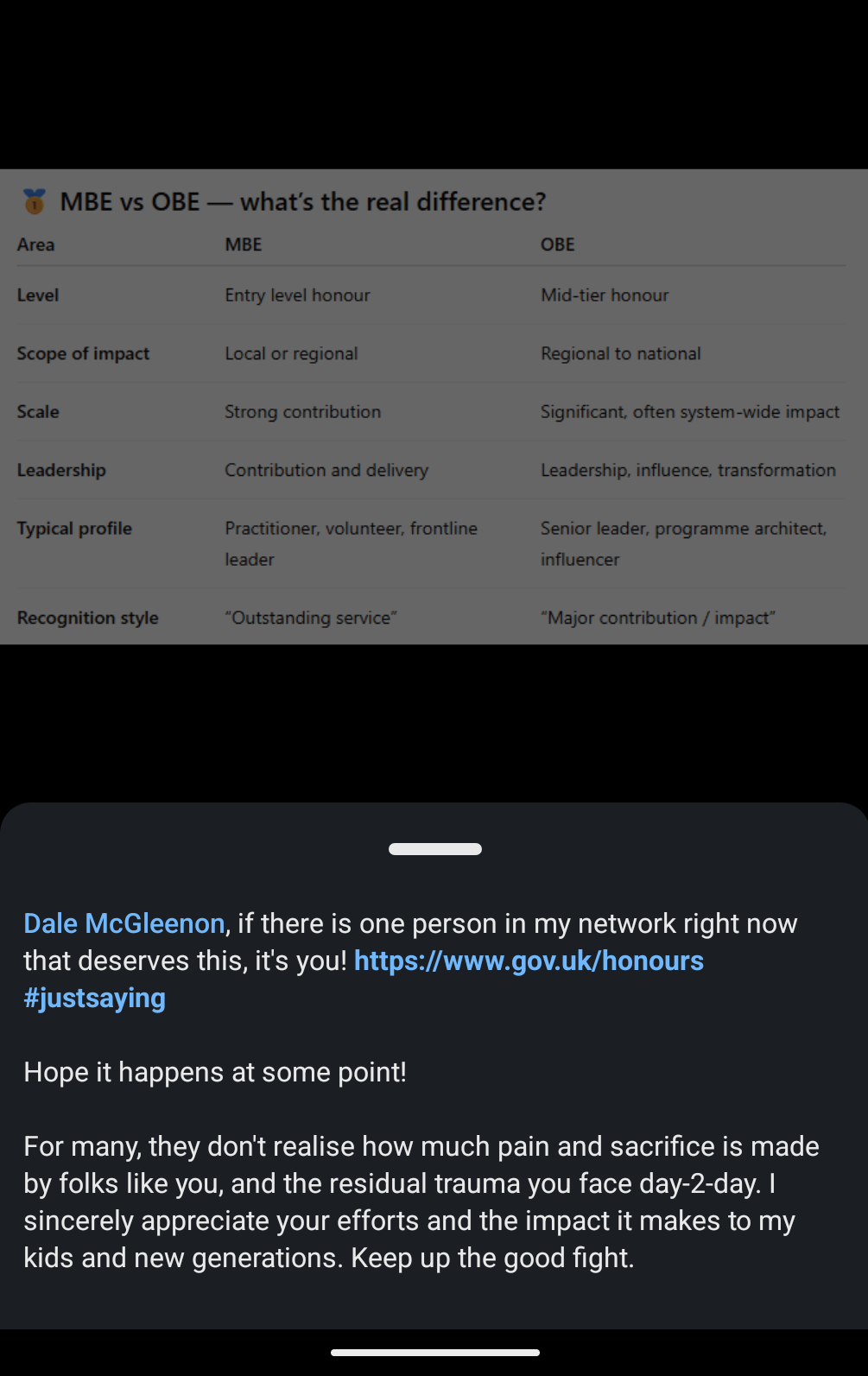
He even shared one of those comparison tables showing the difference between an MBE and an OBE, with a link to the nominations page on gov.uk. And I sat there reading it, genuinely taken aback, because my first reaction was not pride.
It was embarrassment.
Not the false modesty kind. The real kind. The kind where you look at what you do and you think about the teachers who spend their lunch breaks dealing with a safeguarding disclosure they were never trained to handle. The parents who sit up until 2 am researching an app their child has been using because something felt wrong. The volunteers who run youth groups on a shoestring and somehow still find time to care about what is happening on the screens in front of those children.
Those are the people who deserve an honour. Not me.
But that moment, that unexpected tag on a Tuesday afternoon, made me think about something I have never really written about in full. Not just why I do this, but what it actually costs, and who really keeps children safe online.
Where This Started
I served 22 years in the Royal Air Force Police. The last eight of those years were spent in cybersecurity, working in Digital Forensics and Incident Response. It is a job title that sounds clean and technical. It was anything but.
Part of that role involved investigating criminal and inappropriate web browsing sessions. That meant sitting in front of a screen and analysing images, categorising them, grading them against scales that I will never explain to you because nobody should have to carry those details around in their head.
I analysed in excess of one million images during that period. Roughly a quarter of them were criminal.
There was no counselling in place, no psychological support, no structured debrief after a particularly bad day, and there were a lot of bad days. You just got on with it, because that was the culture, you never showed weakness and because the work needed doing, because you told yourself if you didn’t do it, who would.
I was medically discharged from the RAF in 2019 with a diagnosis of Complex Post-Traumatic Stress Disorder.
I will not describe what I saw in those images. I have never done that and I never will. But I will tell you what it felt like. It felt like looking into the eyes of victims who could not speak for themselves and knowing that somewhere, at some point, every single safeguard that should have protected them had failed. Their parents did not know, their teachers did not know and the platforms they were on did not care enough to stop it.
That feeling is what started Cyber Safety Guy. Not a business plan. Not a content strategy. A feeling that if I could not unsee what I had seen, then the very least I could do was try to make sure fewer children ended up in those images in the first place.
I spent eight years inside the evidence. Now I spend my time trying to stop children becoming part of it.
I Am Not the Hero of This Story
Here is what I want you to know. I write blog posts, I make videos, I share information on social media. That matters, I believe it does, but it is not where children are actually protected.
Children are protected at kitchen tables, in school corridors and in quiet conversations that nobody else hears.
A few months ago, a parent messaged me to say that one of my posts about grooming tactics had helped her start a conversation with her 11-year-old daughter. Not a lecture, a conversation. She said her daughter told her something that night that she had been holding onto for weeks. I will not go into the details, but that message is pinned in my inbox and I go back to it on the days when I wonder whether any of this is worth the toll it takes on me mentally.
That parent did the hard bit. Not me. I wrote a blog post. She sat down, found the words, and created a space where her child felt safe enough to speak. That is where protection happens.
The teacher who brings up online safety in a staff meeting, even though it is not on the agenda and nobody asked, that person is protecting children. The Designated Safeguarding Lead, who is managing complex cases while also teaching Year 6 maths, burned out, underfunded and still showing up, that person is protecting children. The grandparent who admits they do not understand Snapchat but asks their grandchild to show them how it works, not to spy on them, but because they want to understand their world, that person is protecting children.
In 2024/25, Childline delivered over 162,000 counselling sessions to children and young people across the UK. More than half of those sessions were about mental and emotional health. Behind every single one of those numbers is a child who reached out because, somewhere along the way, a trusted adult helped them believe that asking for help was not a weakness.
That is what grassroots protection looks like. Not headlines. Not policy announcements. Real people, doing real things, in real time.
Why We Do Not Talk About the Quiet Ones
The King’s New Year Honours List for 2026 recognised 1,157 people. Among them were athletes, actors, and community champions who have done extraordinary things. I am not diminishing any of them. But I want to talk about who is missing.
There are roughly 25,000 schools in England alone. Every single one of them is required to have a Designated Safeguarding Lead. Many of those DSLs are classroom teachers who have taken on the role because somebody had to. They are not safeguarding specialists. They are not paid extra for it. And according to recent research, they are burning out at an alarming rate, expected to manage cases that are growing more complex, while the services they need to refer to are harder to access than ever.
One in five children and young people in the UK now has a probable mental health disorder. Section 47 child protection enquiries hit a record high of over 230,000 in 2025. Schools account for more than one in five of all referrals to children’s social care. The system is creaking, and the people holding it together at the edges are not the ones making the news.
The same is true for parents. Nobody nominates a parent for an honour because they checked their child’s phone with care and without judgment. Nobody writes a profile piece about the mum who spent three evenings learning how Discord servers work because she noticed her son’s behaviour had changed. Nobody hands out awards for the dad who drove an hour to attend an online safety evening at school and actually listened.
But from my perspective, having spent eight years inside the evidence, I can tell you with absolute certainty that those small, unglamorous, invisible acts of care are the single most effective line of defence a child has online. Not filtering software. Not age verification. Not platform safety teams, but a human being who cares enough to pay attention.
My pain can be a shield for your children, but your conversations are the armour they actually wear.
⚡Please don’t forget to react & restack if you appreciate my work. More engagement means more people might see it. ⚡

The Fuel That Keeps This Going
Cyber Safety Guy has been running for over a decade now. I started it in 2013, not long before the world really woke up to how different childhood had become in a connected world. I have written about grooming, about deepfakes, about algorithms that push children toward self-harm content, about platforms that knew there were problems and chose profit over protection.
Every piece I write takes a toll. That is not a complaint, it is just the truth. The subject matter is triggering, and I have C-PTSD for a reason. Some weeks, finishing an article feels like pulling a splinter out of somewhere deep. But I keep going because of the messages. The emails from parents. The DMs from teachers. The occasional comment from a young person who says they showed something I wrote to their friend and it helped.
That is the fuel. Not recognition. Not reach. Not metrics. The knowledge that somewhere, someone read something I wrote and it changed a conversation.
100% of all subscription income from this blog subscription goes to Childline, run by the NSPCC. Every penny. I do not say that to impress you, I say it because it matters that you know this is not a business. It never has been and ever will be. It is my small way of fighting against the predators who live and hide in the darkest corners of the internet. This is a battle that began for me back in 2012, and I am nowhere close to stopping.
So, Who Deserves the Honour?
You do.
If you have ever shared one of these posts with a friend because you thought it might help them have a conversation with their child, you do. If you have ever sat down with a young person and asked them, without judgment, what they are doing online, you do. If you are a teacher reading this in the ten minutes you have between lessons, wondering how you are going to fit safeguarding into an already impossible timetable, you do.
If you are a parent who feels out of your depth with technology but refuses to give up trying to understand it, you absolutely do.
I do not need an MBE. What I need is for more people to do what you are already doing. Keep reading. Keep sharing. Keep talking. Keep showing up.
Because, to be brutally honest, the people who protect children online are not the ones who end up on honours lists. They are the ones who turn up at 7 am, stay late after school, Google things they wish they did not have to, and have conversations that are uncomfortable but necessary.
And they deserve more than a medal. They deserve to know that what they do matters.

As always, thank you for your support. Please share this across your social media, and if you do have any comments, questions, or concerns, then feel free to reach out to me, as I am always happy to spend some time helping to protect children online.
Remember that becoming a paid subscriber means supporting a charity that is very close to my heart and doing amazing things for people. Childline, I will donate all subscriptions collected every six months, as I don’t do any of this for financial gain.

If you or a child you know needs support:
Childline: 116 000 | childline.org.uk
Available 24/7, 365 days a year. Free, confidential, and here for every child.