

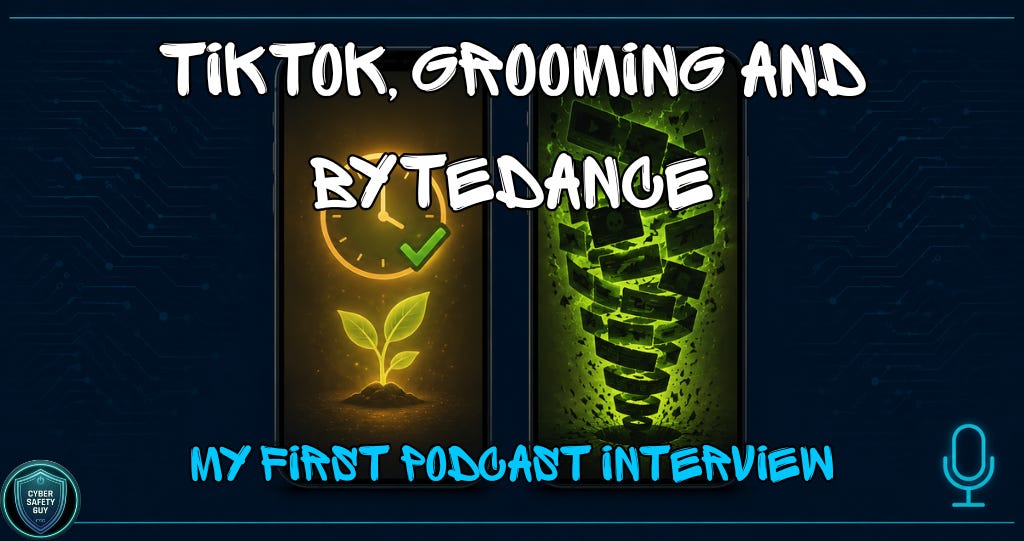

There are two versions of TikTok.
The one your child uses, then the one ByteDance built for children in China, with daily time limits, overnight lockouts, and an algorithm designed to make their lives richer rather than shorter.
They built the safe version because Chinese law required it. They chose not to build it for yours.
That’s where Bora Seker and I started last week on the Dumb Ways To Get Hacked podcast. It was my first time as a guest rather than a host and for nearly two hours, we went into territory I rarely cover in one sitting.
ByteDance and the two-TikTok problem
ByteDance has the technology to protect your child. They built it. It exists, and it works, because Chinese children are using it right now. They chose not to apply it to the international version of TikTok because child safety doesn’t generate profit, but engagement does.

Until regulators make it more expensive to harm children than to protect them, they will keep making business decisions over safety decisions.
They’re feeding salad to Chinese children and opium to everyone else’s.
AI grooming and what eight minutes actually means
A previous guest of Bora’s shared a stat that grooming can now take as little as eight minutes1. When I was working in Digital Forensics and Incident Response within the RAF, building a false identity took weeks of patient work. Now, a convincing profile, a cloned voice, a deepfake video call, all of it can be assembled in minutes with tools anyone can find with a quick search.
We talked about what that means for parents who think they’d spot a fake. The honest answer is that it’s much harder than most people assume, even for experts.
What the algorithm does before a predator says hello
Before any predator makes contact, the algorithm has often already done the groundwork. It finds children questioning their worth and serves them content that makes it worse. By the time someone online says I understand you, you’re perfect, the child has been made ready to hear it.
The doomscroll isn’t just a mental health problem. It generates the conditions predators need, built quietly by platforms that profit from it.
⚡Please don’t forget to react & restack if you appreciate my work. More engagement means more people might see it. ⚡

What this work actually costs
Bora asked me directly, and I was, as always, honest. The version of me that started that DFIR role didn’t survive it. What I wear now is a mask. Most people get the version of me who has it together. The only person who sees behind it is Colleen.
I talked about the C-PTSD diagnosis in 2018, the medication I’ll probably be on for the rest of my life, and the somniphobia that means I write on this platform at 3 am rather than sleep, because I still go to bed to try and make life as normal as possible for Colleen.
I also talked about Leffe, my French Bulldog, who was with me for most of that journey and passed away in December. He was my pebble. It’s quieter and lonelier without him.
I don’t often go that deep in one conversation. Worth watching if you want to know more about those parts of me and my story.
What parents can actually do
We came back to this at the end, because I always do. Technical controls matter, of course, they do, so set them up. But they can and will fail. What protects a child when they do is a trusted adult they know will help them, not punish them.
That relationship starts long before anything goes wrong, with small, ongoing, non-judgmental conversations about what their online life actually looks like. Not a formal talk, just an open door that they know they can go through anytime, 24/7.
The full episode is 45 minutes. Bora is a sharp interviewer and I think there’s something in this conversation worth your time, whether you’re a parent, a teacher, or you work in safeguarding.
👉 Watch here:

As always, thank you for your support. Please share this across your social media, and if you do have any comments, questions, or concerns, then feel free to reach out to me via the Social page, as I am always happy to spend some time helping to protect children online.
Remember that becoming a paid subscriber means supporting a charity very close to my heart and helping it do amazing things for people. Childline, I will donate 100% of paid subscriptions collected every six months, as I don’t do any of this for financial gain.

If you or a child you know needs support:
Childline: 0800 1111 | childline.org.uk
Available 24/7, 365 days a year. Free, confidential, and here for every child.
Eight-minute grooming statistic cited in podcast discussion.
Note: Shared by a previous podcast guest. Independent verification from primary research recommended before citing in formal safeguarding contexts.