

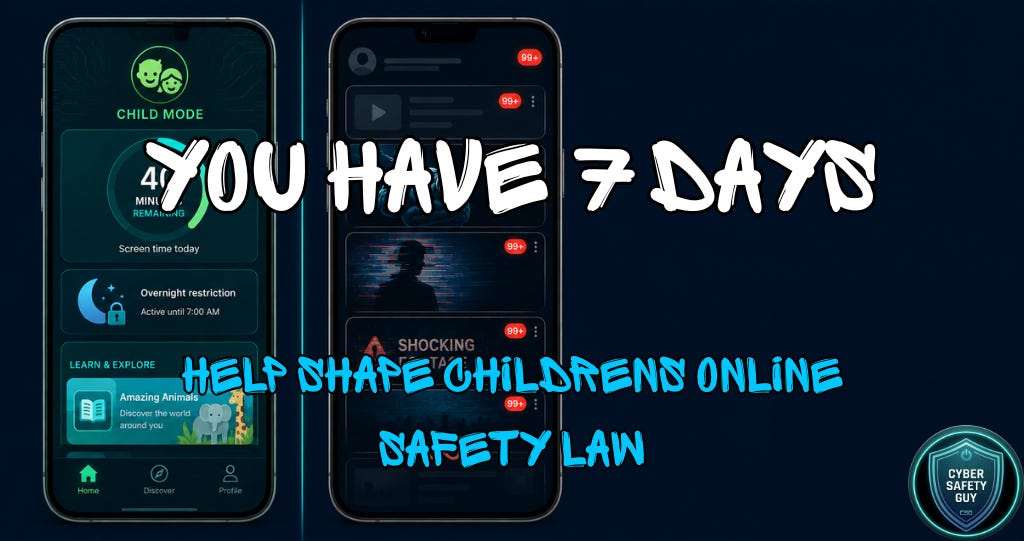
There are 7 days left.
That is how long you have to tell the UK government what you think about children’s online safety. Not as a comment on a post, not as a reply to a thread, but as a formal consultation response, on record, that feeds directly into future legislation.
The consultation, titled “Growing up in the online world,” was published by the Department for Science, Innovation and Technology on 2 March 2026. It closes at 11:59 pm on 26 May 2026.1 [5]
Most parents and teachers I have spoken to have no idea it exists. That is not a surprise. Government consultations, just like my content on child safety, are not exactly known for going viral. This one matters more than most and this is why.
We Already Know What’s Possible
Before I get into what the consultation actually covers, I want to come back to something I wrote about in March, because it is the most important piece of context for everything that follows.2
ByteDance, the Chinese company that owns TikTok, also operates a completely separate version of the same app inside China, called Douyin. And what children in China get on Douyin is radically different from what your child gets on TikTok.


In China, any child under 14 who opens Douyin is automatically placed into Youth Mode. No opt-in required, no settings menu to navigate, it switches on by default. That means a 40-minute daily time limit, an overnight lockout between 10 pm and 6 am and an algorithm that serves science experiments, museum exhibits, and educational material instead of entertainment-led content. There are even deliberate five-second pauses between videos, with prompts that say things like “put down the phone” and “go to bed.”
In the UK? None of that. Your child gets the same algorithm as an adult. TikTok introduced a 60-minute daily limit for under-18s in 2023, but teenagers aged 13 to 18 can override that limit themselves without any parental involvement.3 Research has shown that newly registered teen accounts can be served self-harm and eating disorder content within minutes of signing up.4
The same company. The same underlying technology. Two completely different products.
“ByteDance makes a ‘spinach version’ of the app for Chinese children and ships the ‘opium version’ to the rest of the world.” - Tristan Harris, Centre for Humane Technology 5
Why? Not because building the protected version here is technically impossible. They have already built it, so the technology exists. What has not existed, until now, is a government that has formally asked whether we should require platforms to use it here.
That is exactly what this consultation is.
What the Consultation Actually Covers
This is not a vague well-being exercise. The government is consulting on specific, concrete measures.
A minimum age for children to access social media, and what that age should be.
Restrictions on addictive design features that encourage excessive use, including infinite scrolling and autoplay.
Whether the digital age of consent should be raised.
How age-verification and age-assurance technologies can be used to enforce these changes effectively.
Whether the existing guidance on mobile phones in schools should be made statutory.
Better support for parents and carers, including clearer guidance and simpler, standardised parental control tools.
These are not small questions. The answers will shape what online platforms are legally required to do, and what Ofcom has the power to enforce.
⚡Please don’t forget to react & restack if you appreciate my work. More engagement means more people might see it. ⚡

Three Surveys. One Deadline.
There are three separate surveys available:
A full consultation, open to anyone, including civil society organisations, industry, and members of the public.
A survey specifically for parents and carers of young people aged 21 and under.
A survey for children and young people aged 10 to 21.
That last one is very important. Children’s voices are not often formally invited into policy processes at this level. If you have a young person aged between 10 and 21 in your life, please share this with them.
Why Your Voice Matters
Government consultations receive responses from the platforms and from industry representatives. Those voices will be heard, the question is whether they are the only voices heard.
Every parent who takes 15 minutes to respond, every teacher, every DSL, every safeguarding professional and every person who has seen first-hand what happens when platforms are not held to account. Those responses matter, they are on record and they will inform what becomes law.
From my own experience, analysing evidence of what happens to children when online spaces are not safe, I can tell you that the distance between policy and lived reality is often enormous. The people who close that gap are the ones who show up when asked.
You are being asked. Please show up!
How to Respond
Go to www.gov.uk and search for “Growing up in the online world consultation.”
The three surveys are accessible from there. I have completed the full consultation and it takes roughly 15 to 20 minutes. The parents and carers survey is shorter, you do not need to answer every question and you do not need specialist knowledge to participate.
The consultation closes at 11:59 pm on 26 May 2026.
Please do not leave it until the last day, also, please do not assume that someone else will do it.
What I Want to See Come Out of This
In my view, the most important outcome of this consultation is not just age verification, as important as that is. Age verification is step one; what matters is what happens after the check.
Knowing that a user is 12 years old and then continuing to serve them the same algorithm as a 35-year-old is not child safety, It is merely compliance theatre.
ByteDance has already proven that the technology exists to do better. They built a protected version of TikTok that changes the entire product experience for children, because the Chinese government demanded it. They can build the same here. They choose not to because nobody has legally required it.
This consultation is the beginning of changing that.

As always, thank you for your support. Please share this across your social media, and if you do have any comments, questions, or concerns, then feel free to reach out to me via the Social page, as I am always happy to spend some time helping to protect children online.
Remember that becoming a paid subscriber means supporting a charity very close to my heart and helping it do amazing things for people. Childline, I will donate 100% of paid subscriptions collected every six months, as I don’t do any of this for financial gain.

If you or a child you know needs support:
Childline: 0800 1111 | childline.org.uk
Available 24/7, 365 days a year. Free, confidential, and here for every child.
Growing up in the online world: a national consultation - Department for Science, Innovation and Technology, gov.uk, published 2 March 2026, closes 26 May 2026. Accessed 15 May 2026. Primary government source.
ByteDance Protects Chinese Children. So Why Doesn’t It Protect Ours? - Dale (Cyber Safety Guy), cybersafetyguy.com, published 24 March 2026. Author’s own research and analysis. Held on file.
TikTok screen time and Family Pairing settings for under-18s - TikTok Newsroom / Help Centre, tiktok.com. Accessed May 2026. Note: platform settings are subject to change; verify current configuration at support.tiktok.com.
Research into TikTok algorithm and harmful content recommendations to new teen accounts - Multiple independent studies and media investigations. Sources held on file. Note: findings are based on third-party testing; TikTok disputes some methodologies.
Tristan Harris, Centre for Humane Technology - “spinach version / opium version” framing. Widely reported; original source held on file. Inferred from author’s prior research and public media reporting.
Argh, I just wrote a long comment about the work I'm doing with kids on the young person's survey at the moment and, ironically, it timed out. It's a fully, ethics committee approved piece of research, on the way that the questions are being asked. I'm working with 9-21 year olds and...they have concerns (all the way through from the 9 year olds up to the 21 year olds!!). I have concerns! I have a RAFT of tips for parents who might want to help their kids fill in the young person's survey; would it be helpful for me to write them up somewhere?
In short, though, what I am seeing from the research so far (which, to the point about ByteDance, has also included the voices of Chinese students towards the top of the age range) -- there is a real concern that the way the questions are structured do not allow for young people to give the answers they want to. There is no option to offer alternative policy options (e.g. why 16? why not 14, 13 or not at all? And why not holistic regulations? -- adults get to answer this). The survey is too long, and most kids so far have suggested they'd zone out (indeed there are no attention check questions, which is horrific survey design in something that too me -- a fully fledged expert adult -- 40 minutes to go through). They get asked counterfactual questions ("what would you be doing if you weren't on social media?"), impossible to answer questions ("how does social media makes you feel?" -- as a multiple choice question with no option to explain further), and free text questions with only two lines visible to type in -- and no prior warning of what the question is, or explanation as to whether the screen will time out. Bluntly, too, they are quite angry that something they've had access to, and built their lives around will just be taken away. Or, rather, that they know it will be "taken away"; they know that a ban is nonsense in terms of changing anything. And so it makes them angry that this will be the policy solution that stops more wide ranging change.
It's a bit of a mess. That's not to say that parents shouldn't support their kids in answering the survey. But I do want them to help their kids understand the extreme limitations of the way they're being asked about something incredibly important to them...